The temporary column titled “Close Up” is the result of a collaboration between Flash Art Italia and Istituto Svizzero, and focuses on editorial hosting as a practice of sharing research. “Close Up” is conceived as an editorial space that hosts texts by writers invited by Istituto Svizzero to engage with and reflect on the practices of the artists in residence participating in the Roma Calling 2025/2026 programme.
Paul Hutzli (1992) is an artist based in Geneva. His work investigates the relationship between the individual and the social environment, exploring how the latter shapes personal identity. He studied at ESAM in Caen and at HEAD – Genève, and has exhibited at Kunsthalle Bern, the Centre d’Art Contemporain Geneva, Halle Nord, and the Dzielna Foundation in Warsaw. In Rome, he delved into the study of trompe-l’œil in baroque churches and carnival symbolism as part of a site-specific installation.
“It would be extremely interesting to write a history of laughter.”
(Mikhail Bakhtin opens his book Rabelais and His World (1965) with this quote by the Russian philosopher Aleksander Herzen.)
Have you ever walked through the streets of a city in the hours immediately following the end of Carnival? I have particularly vivid childhood memories of the Viareggio Carnival, walking along the seafront promenade on my way home, perhaps after a sudden spell of cold rain had brought the festivities to an early close. The paper from confetti and streamers, mixed with dust and windblown sand and soaked through by rain, formed a shapeless mass that stuck to the soles of shoes and to the trailing hems of costumes. There is something both melancholic and intensely physical in that substance: the residue of celebration, what remains once the play structures dissolve and the body returns to being simply a body walking in the rain. Carnival has fulfilled its task, and what it leaves scattered on the ground is paper, colour, water, sand – particulate matter carried into the air by the wind and brought back down to earth by gravity.
These images came back to me while speaking with the artist Paul Hutzli in his studio at the Swiss Institute in Rome. We found our first bit of common ground in Mikhail Bakhtin’s essay on François Rabelais’s Gargantua and Pantagruel, a key reference in Hutzli’s Master’s thesis on the Basel Carnival. We both share the conviction that carnival grotesque constitutes a social and political phenomenon worthy of study, a lens through which to revisit and reactivate the space of folklore, so often relegated to a minor or vulgar status, a repository “where traditions are museified”, as the artist remarked, finding me in perfect agreement.
For Bakhtin, Carnival is the moment when the symbolic order of power is overturned, when high and low exchange places, when the body – with its openings, its secretions, its hunger – returns to centre stage. It is an epistemology of fleeting inversion: it ends when the masks are removed, yet nonetheless carries within it a potential for renewal and re-emergence elsewhere. Looking at Paul Hutzli’s works, I felt inclined to place them precisely in that aftermath, within that residue not yet reclaimed, where the materials and subjects he employs are themselves sediments of a past rebellion to which no one pays much attention anymore. “Often,” he told me during our conversation, “wherever there is political tension or violence, Carnival becomes a way of giving it form. Not of resolving it, but of giving it a form.”
Schoolchairs (2025), for instance, is an installation composed of school chairs reproduced by the artist in papier-mâché and distributed around the exhibition space in a deliberately chaotic manner. The chairs faithfully replicate a model commonly found in Swiss and Italian schools, with a tubular chrome-plated metal frame and warm-honey-orange moulded plywood seat and backrest. The reproduction – wood grain, contours of the surfaces, proportions of the legs – is accurate enough to fool the eye at a distance. But Hutzli also appropriates the gestures of micro-rebellion that students typically leave on such chairs – stickers, inscriptions, scratches, and chewing gum stuck to the bottom of the seat – and transforms them into artistic interventions. One of the chairs is overturned to reveal its underside and a depiction of Cockaigne, the mythical medieval utopia in which food falls from the sky and people are finally freed of the burden of labour. Cockaigne, the land of contraries, is the opposite of the work ethic that schools are tasked with transmitting, and placing it on the underside of a school chair, at the very point where corporal discipline is exercised most directly, is a gesture with the precision of a syllogism and the lightness of a laugh.
Speaking of laughter, Mikhail Bakhtin opens his book on Rabelais with a quotation from the Russian philosopher Alexander Herzen – the same quotation that opens this text. In doing so, he points to a gap in the historicization of laughter, to a form of repression. Laughter is an instrument of cultural and social emancipation, a mode of knowledge that the official mindset has always sought to marginalize, to reduce – at best to satire or entertainment –, to neutralize by dissolution in the vast and amorphous realm of folklore. To write a history of laughter would therefore mean writing the history of everything that power has systematically attempted to dismiss as unserious, but which – through recurring acts of rebellion – has continued to survive, to be transmitted, and to re-emerge wherever cracks open in the structures of order.
The papier-mâché that Hutzli employs in many of his works is the quintessential carnival medium, as ephemeral as Carnival’s brief recurrence in the calendar. The artist learned the technique directly from the artisans of the Basel Carnival, who use it to make the masks known as Larven, from the Latin larva, meaning spectre, ghost, but also mask. The mask reveals a truth that the everyday face cannot afford to disclose and can embody what Bakhtin called “ambivalent laughter”: a form of mockery that is at once joyful and serious, capable of exercising social critique through irony. It is precisely within this tension, I believe, that Hutzli’s work on school chairs is situated. These papier-mâché chairs are not accusatory vis-à-vis the school – an institution in which Hutzli himself taught for several years – but rather “wear” it like a mask, looking at it from within, turning it upside down for a moment in order to glimpse what might lie on the other side.
This attitude, which might be described as carnivalesque not because of any thematic analogy but because of its underlying structure, recurs throughout Hutzli’s practice, where techniques of trompe-l’œil and gentle deception become means of triggering continual reversals of meaning. Such is the case with the series Plates (2023), inspired by eighteenth-century French Niderviller faience and reproduced in papier-mâché, featuring scenes out of medieval folklore associated with food or openly revolutionary figures antagonistic to the aristocratic class for whom these ceramics were originally produced. Here Hutzli’s irony is directed at a quintessentially bourgeois object – the decorative serving plate – emptied of its original motifs and filled instead with counter-narratives reflecting on the hunger endured by the poorest social classes. The plate that once held the master’s meal thus becomes the support for narrating a world turned upside down, one in which food becomes a tool for redressing the systemic injustices that characterize relations between classes.
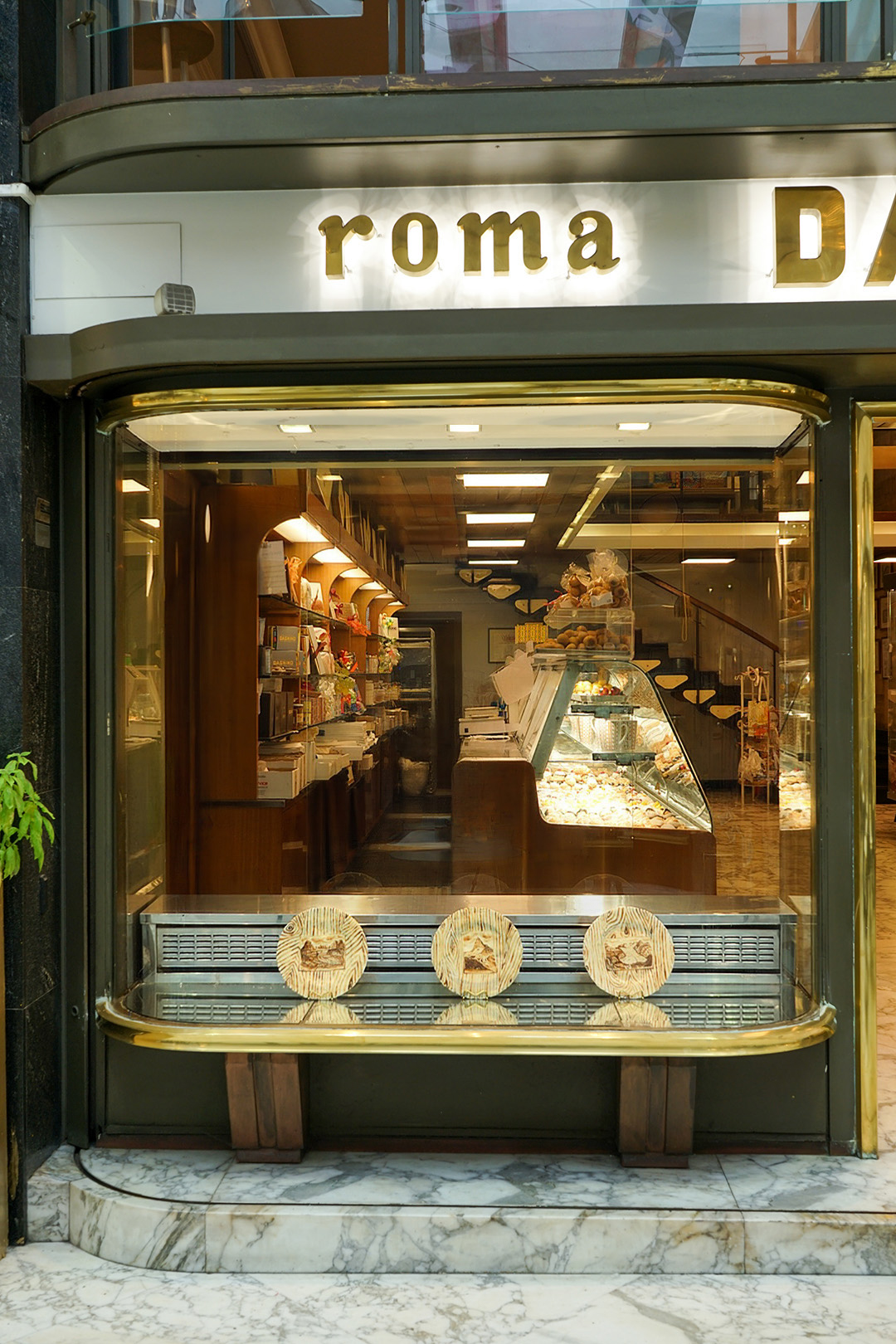
In another series of plates, Switzerland Sweet Switzerland (2025), this time made of chocolate and produced for an exhibition that lasted only a few days at Rome’s Dagnino pastry shop, the same approach is deployed through a gesture made even more explicit by the perishability of the work itself. Swiss chocolate is one of the country’s great national myths, built upon a marketing narrative that has deliberately shifted attention away from Brazilian cocoa plantations exploited through Swiss colonial extraction and towards milk production in the pure air of the Alps. With an annual per-capita consumption of eleven kilograms of chocolate, Switzerland consumes enormous quantities of a raw material that does not grow there and whose production entails significant emissions that the official narrative prefers not to address. Hutzli uses chocolate to depict stereotypical Swiss landscapes on the plates – cows grazing in alpine meadows – fully aware that they will melt, just like the glaciers that populate postcard-perfect Swiss scenery and are now threatened by the climate crisis. Installed within the Roman pastry shop, the work becomes a small theatrical device that, for the duration of the chocolate’s melting process, reveals the capitalist contradiction underlying a supposedly quintessential Swiss product, one that the artist chooses to mock in both form and substance.
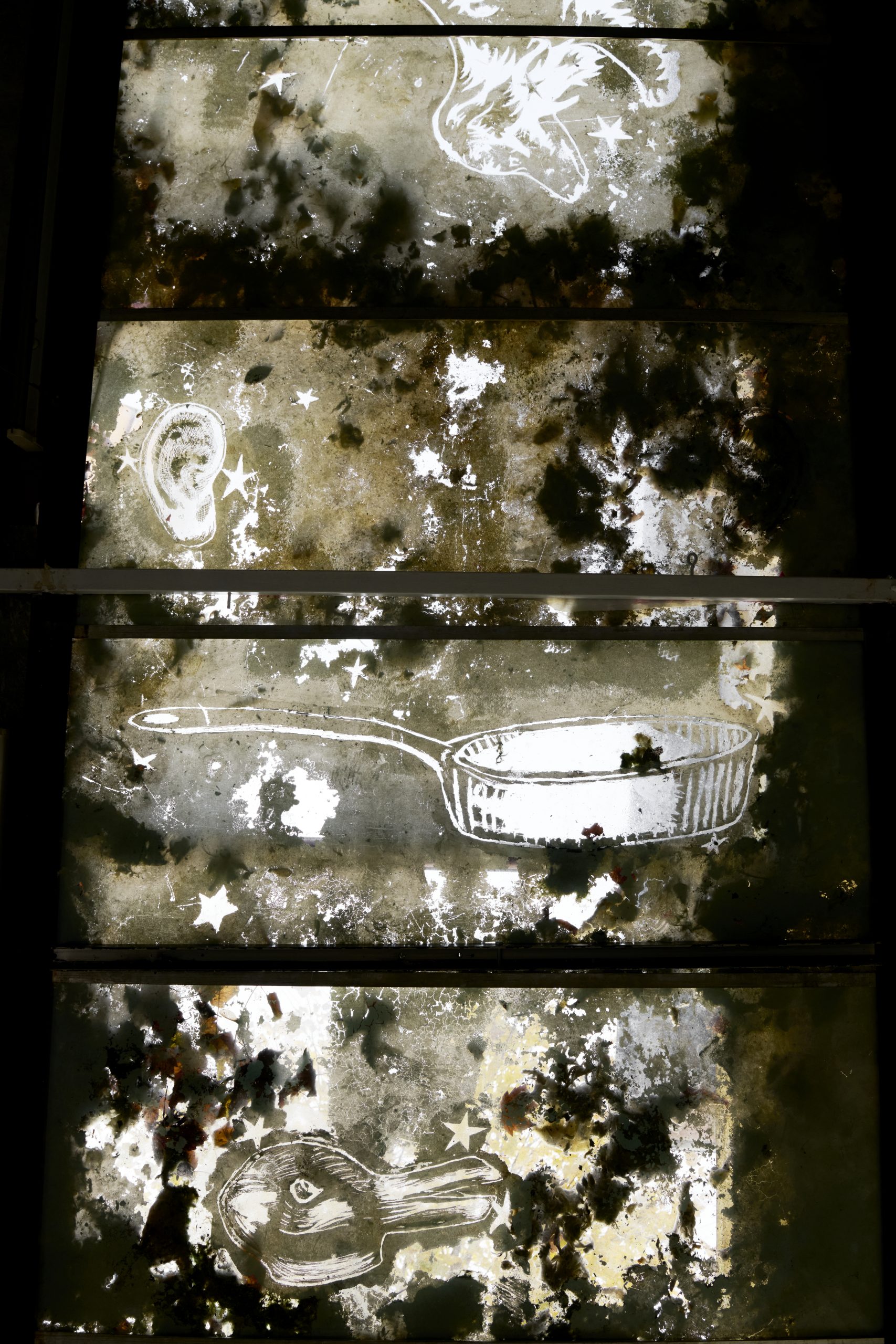
In Lausanne, in a house that had long belonged to an artist and then stood abandoned for some thirty years, Hutzli found a skylight entirely covered by a layer of dust and encrusted grime, where decades of accumulation had all but blocked the passage of light. Rather than removing this sedimentation, the artist chose to inscribe within it a temporary image. He etched a map of the Lausanne sky into the layer of dirt, introducing invented elements: a dog – in tribute to the now-deceased pet that once lived in the house –, a frying pan, an ear, a duck. It was much like when he was a child and his paediatrician would give him sheets filled with stars to connect, and he would project the images of his own inner world onto them. Hence the title Rohrschachsterne (2024), a play on words combining the imagery of the Swiss psychologist Rorschach’s ink blots with the German word for stars (Sterne).
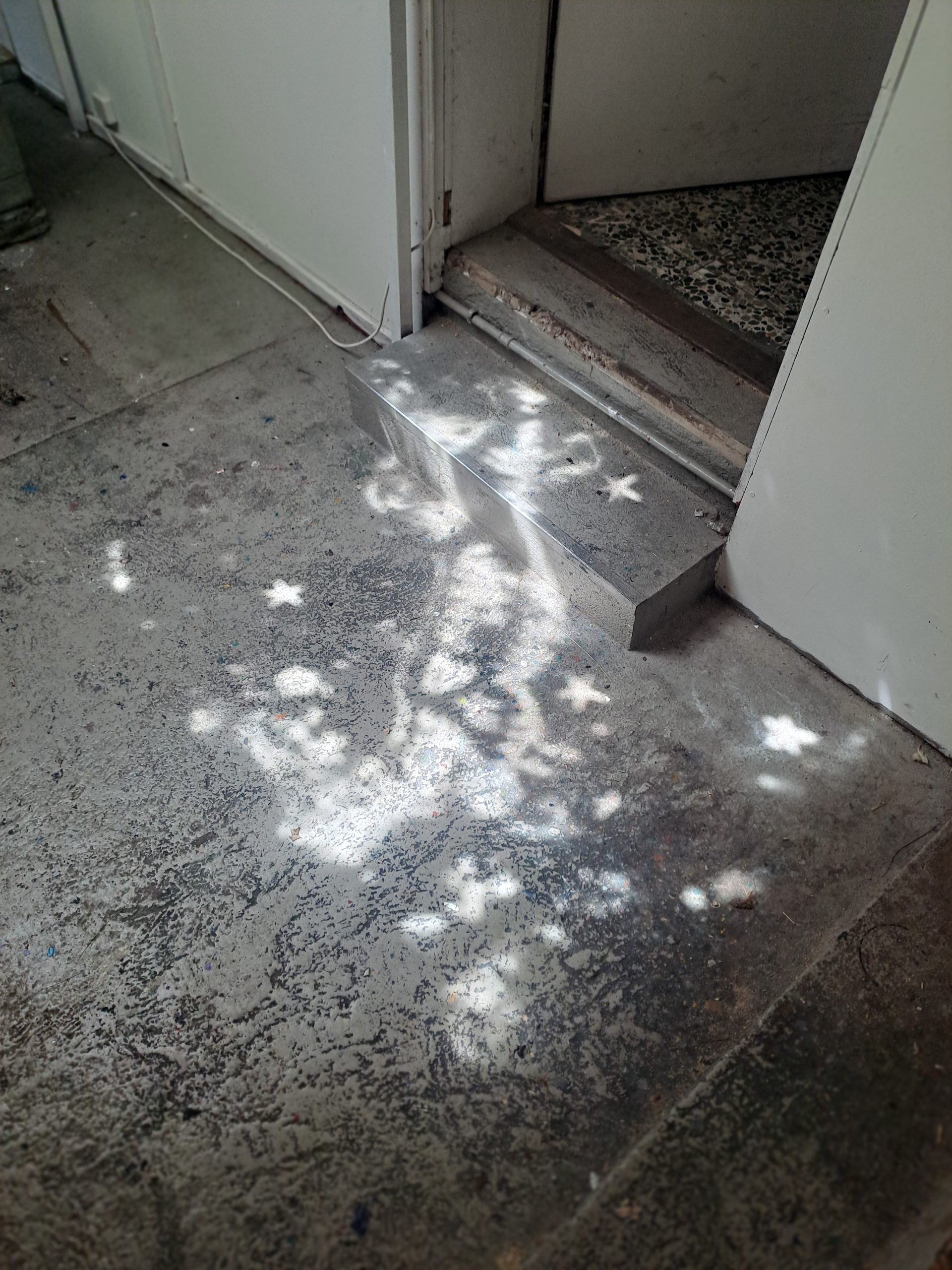
Creating the lines of his drawing by removing the dirt, Hutzli allowed light to pass through, projecting a luminous array of stars onto the floor that would remain visible only until more dust accumulated. The work is founded on the idea of discovering a form capable of emerging at the intersection between the history of a building and the artist’s personal history, like an epiphany made possible through the destabilization of the meaning we ordinarily attribute to waste. If I were to connect this work to one of my own childhood memories, I would perhaps think of the potential contained within that shapeless mass of confetti, dust, and sand that gathered beneath my feet as a child on my way home from Carnival.
Paul Hutzli is an artist whose practice embraces papier-mâché, stop-motion animation, sculpture, environmental installation, and numerous other techniques capable of generating illusion, while finding in Carnival – not as a subject, but as a method – its gravitational centre. To work in the time immediately following Carnival is therefore to acknowledge that one is operating within a residual and ephemeral space, where subversion resides in the gesture of giving temporary form to the ambivalence of the things that populate everyday life. Papier-mâché is fragile, chocolate melts, engraved dust is eventually covered by new particulate matter, yet attempting to give form to immateriality remains a rebellious act: one that protects laughter from museification while still striving to write a possible history of it.
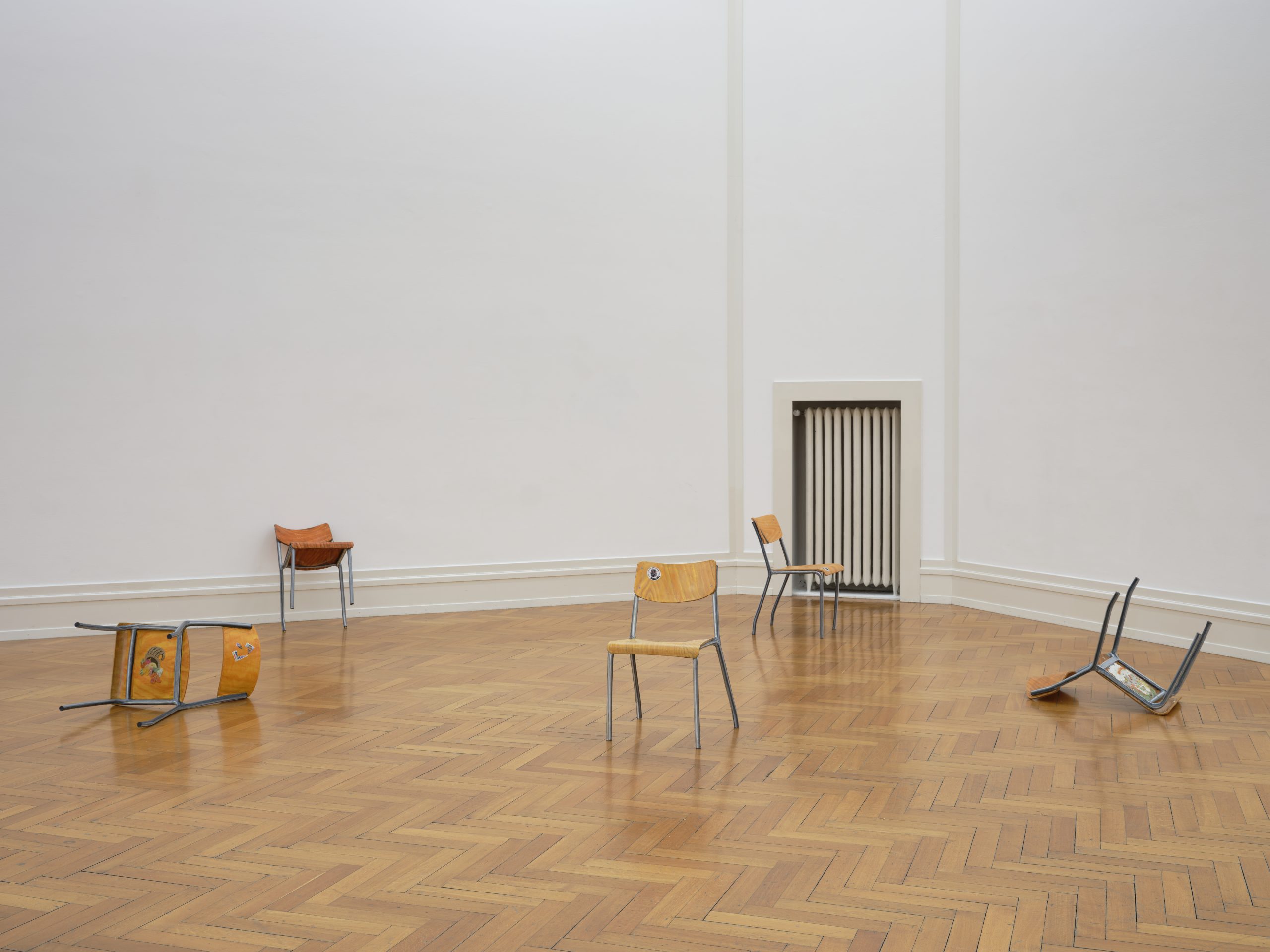
Chaises d’ecole
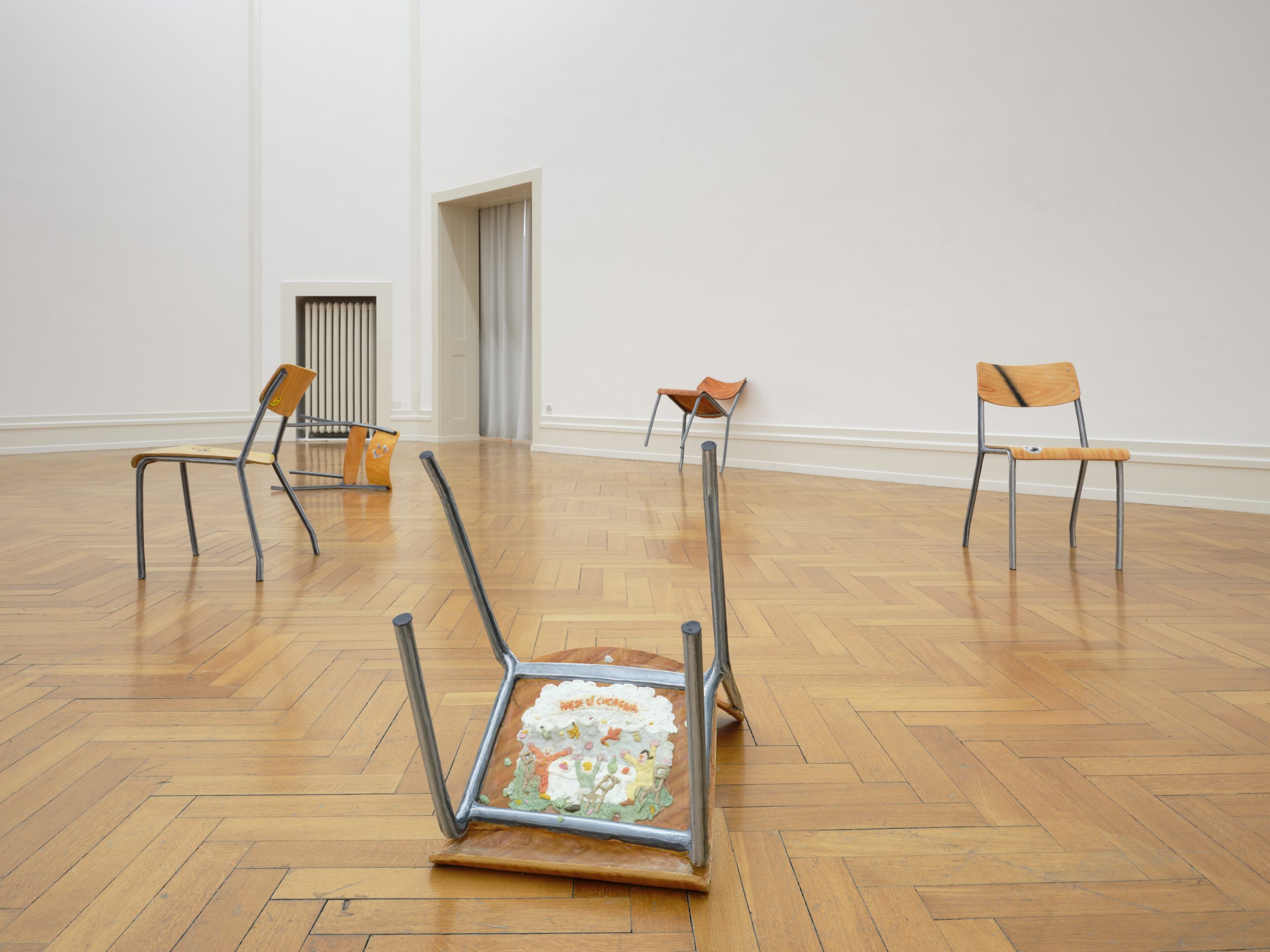
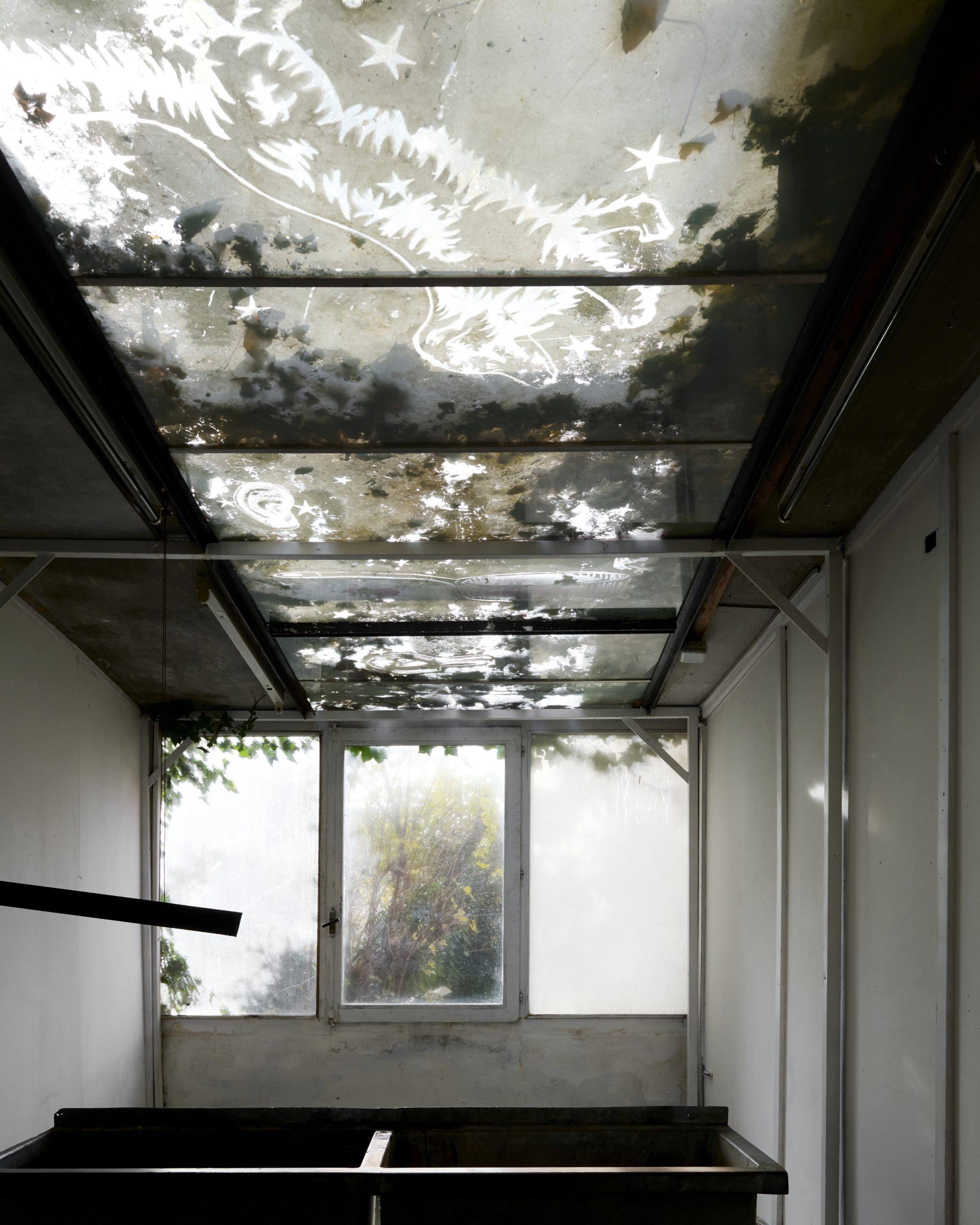
Rohrschachsterne
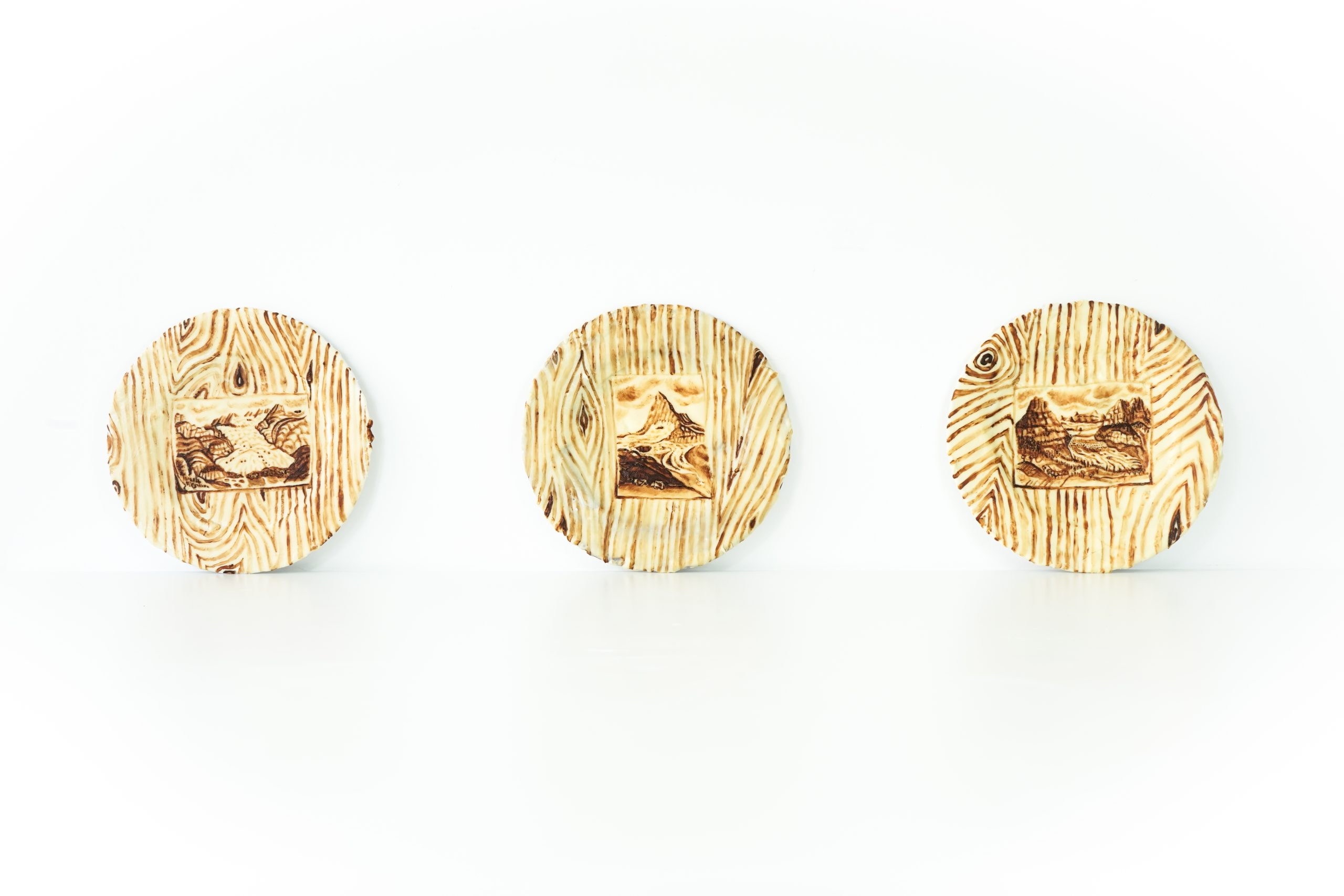
Switzerland sweet Switzerland