The temporary column titled “Close Up” is the result of a collaboration between Flash Art Italia and Istituto Svizzero, and focuses on editorial hosting as a practice of sharing research. “Close Up” is conceived as an editorial space that hosts texts by writers invited by Istituto Svizzero to engage with and reflect on the practices of the artists in residence participating in the Roma Calling 2025/2026 programme.
Gabriel Stöckli (1991) is an artist living between Milan and the Canton of Ticino. His work employs raw materials and found objects to reassign meaning to the everyday. After studying at CSIA in Lugano and NABA in Milan, he has co-directed the Sonnenstube art space in Lugano since 2014. In 2023, he took part in the Cité Internationale des Arts residency in Paris and published his first monograph, supported by the Cahiers d’Artistes award from Pro Helvetia. He regularly exhibits in Switzerland and abroad. In Rome, he developed „That’s Entertainment“, a project that reconstructs miniature environments at full scale as interdisciplinary participatory spaces, exploring the relationship between visual art, music, and field recording, with a particular focus on the work of Alvin Curran.
I have always wondered whether a studio full of things – books, notes, scattered traces – encourages the flourishing of artworks, as though creation were a matter of accumulation, waiting for ideas to overflow. Or perhaps the exact opposite is true: maybe an uncluttered atelier allows thought to move more freely, avoiding the conditioning of other images, words, and signs. Gabriel Stöckli seems to belong to the category of those who prefer to have empty space around them. The studio the artist is temporarily occupying at Istituto Svizzero in Rome resembles more a small office, tidy and somewhat anonymous, as though he had wanted to keep the city’s proverbial disorder outside his room.
The condition in which his workspace presents itself would seem to stand in open contradiction to the works Stöckli creates. His practice often manifests through assemblages of materials accumulated over time: scraps of paper, residual elements, objects of the most disparate kinds. These appear in the series titled Cassetto (Drawer). They are containers – small-format boxes – left half-open: despite their industrial appearance, the “drawers” were handmade by the artist, who assembled the various parts and positioned lights and all sorts of objects inside them. The viewer is invited to peek into these miniature worlds, anomalous dioramas before which one almost wishes to become a Lilliputian and step inside. A compulsive yet selective accumulator, Stöckli told me that the objects used to “furnish” these microspaces had been set aside over many years.
In other works as well, the artist has elevated the residual element into an essential component. One example is All’entrata dell’occhio (At the Entrance of the Eye), an existential freight train: photographs, erasers, and scraps are piled into the wagons of this tiny locomotive, endlessly moving in circles without a destination. The artist imagined that this work could also be seen from outside the exhibition space where it was presented – Spazio Lampo in Chiasso – which features a large street-facing window. Stöckli, however, screened the window with tracing paper and, by directing a light onto the train and its tracks, caused their image to filter outward in the form of shadows – a phantasmagoria – exploiting the principle of the magic lantern. All’entrata dell’occhio thus lives through a double vision: one more distant, almost akin to Plato’s cave, based on the projection of shadows that emphasize the train’s scale and circular movement; and another at close range, where the theatrical machinery reveals both its functioning and its actual dimensions.
Both of the works we have discussed – the Cassetto series and All’entrata dell’occhio – were exhibited on the occasion of Gabriel Stöckli’s latest solo show. The entire exhibition can be read as a light and poetic monument dedicated to childhood, to distant memories resurfacing like shards in the form of familiar objects. Accumulation and fragmentation are undoubtedly two defining traits of the artist’s poetics, although the fragility that characterizes the works is carefully controlled: Stöckli’s works are permeated by a spontaneous grace that allows even the most precarious compositions not to collapse. This seems to me one of the fortunate ambiguities upon which the artist’s practice rests.
When I speak of “ambiguity”, I mean tensions internal to the work, disorientations, small perceptual stumbles. Let us return again to All’entrata dell’occhio: the possibility that the same work presents itself in different forms depending on the viewer’s point of view belongs precisely to the intellectual framework we have just mentioned. Stöckli achieves this result through an analogue special effect based on lighting and veiling, creating, as mentioned, a sort of magic lantern. It is thanks to this device that the view from outside and from inside the exhibition space differ: from outside we see the simulacrum of the little train, from inside its actual appearance. The problem of vision – if one may call it that – also concerns Cassetto. As we have noted, it is a work to spy on, requiring close proximity and intimate contact. Here too Stöckli proposes a concealment: the drawer – by definition a place sheltered from indiscreet gazes – is not completely open, and its contents remain opaque. The same applies to Paper Bag, a grocery paper bag in which Stöckli has opened a small window (not an irregular tear, but a rather precise cut, once again returning to the balance between formalization and precariousness). Inside, a short amateur video loops endlessly, showing a pianist struggling with a piece vaguely reminiscent of Hallelujah by Leonard Cohen. Once again, we are presented with a semi-hidden content that the artist invites us to spy on rather than simply observe.
The inversion of scale is another of the devices Stöckli constantly employs. Beyond the little train of All’entrata dell’occhio (large from the outside, resized once inside the exhibition space), we find it in an alternative version of Paper Bag: here the bag is enlarged out of proportion, yet the photograph portraying it is taken from a perspective that makes it appear tiny. Scala Via Peschiera offers yet another optical illusion: in the photograph, the artist holds a cement model of a staircase that, once again through a trompe-l’œil effect, seems to extend the steps of a real staircase in the background.
What strikes me in Stöckli’s work is another aspect running throughout his entire production: its irreducible DIY (Do It Yourself) dimension. Every work – truly every one – is self-produced, sometimes based on the reuse of materials and, more generally, embracing an economy of means and resources. The analogue special effects I have already mentioned are achieved through explicitly simple techniques, almost appropriating the tricks of tourists’ photographs in which people pretend to hold up the Leaning Tower of Pisa or lift the Great Pyramid of Giza by grasping its tip. In other cases, the work emerges through a process of stripping away: in Seven Layers, for example, the artist removed layers from skateboard decks to reveal their innermost core, where unexpected patterns emerge, a sort of unconscious painting generated by the industrial production of the object.
The references I seem to read in these works are rather conscious; above all Marcel Duchamp, from whom Stöckli borrows a certain attraction to the readymade, to reduced formats and portability (one need only think of Boîte-en-valise), and finally to the hidden side of things, which may lead to forms of voyeurism (after all, the Cassetto series and even the video contained within Paper Bag are experienced in a manner not entirely unlike Étant donnés with its peepholes). Yet beyond any formal aspect or model, I have wondered what matrix of thought underlies Stöckli’s practice. I am fairly convinced that, at the base of his work, there lies an eminently generational question: in the small scale, in the economy of means, in the precariousness of materials, in the recourse to memory as refuge, I find the expression of the existential condition of those who today are between thirty and forty years old in a declining West. A condition forced to contend with apparently limitless possibilities of choice and the sense of frustration deriving precisely from betrayed expectations, economic fragility, ideological uncertainty, and emotional instability.
Stöckli reacts in his own way, recreating miniature worlds in which one might imagine finding shelter. His practice brings to mind that of a stubborn, visionary bricoleur with a touch of shyness. In a recent group exhibition, his work – a pair of canvas sneakers frozen in the act of rising onto their toes, resting on a cardboard box – occupied the corner of the room: I cannot help but think of this piece as a self-portrait à la Gino de Dominicis, self-ironic and invisible. It would, all things considered, seem entirely plausible on the part of the most Italian Swiss person I have ever met.
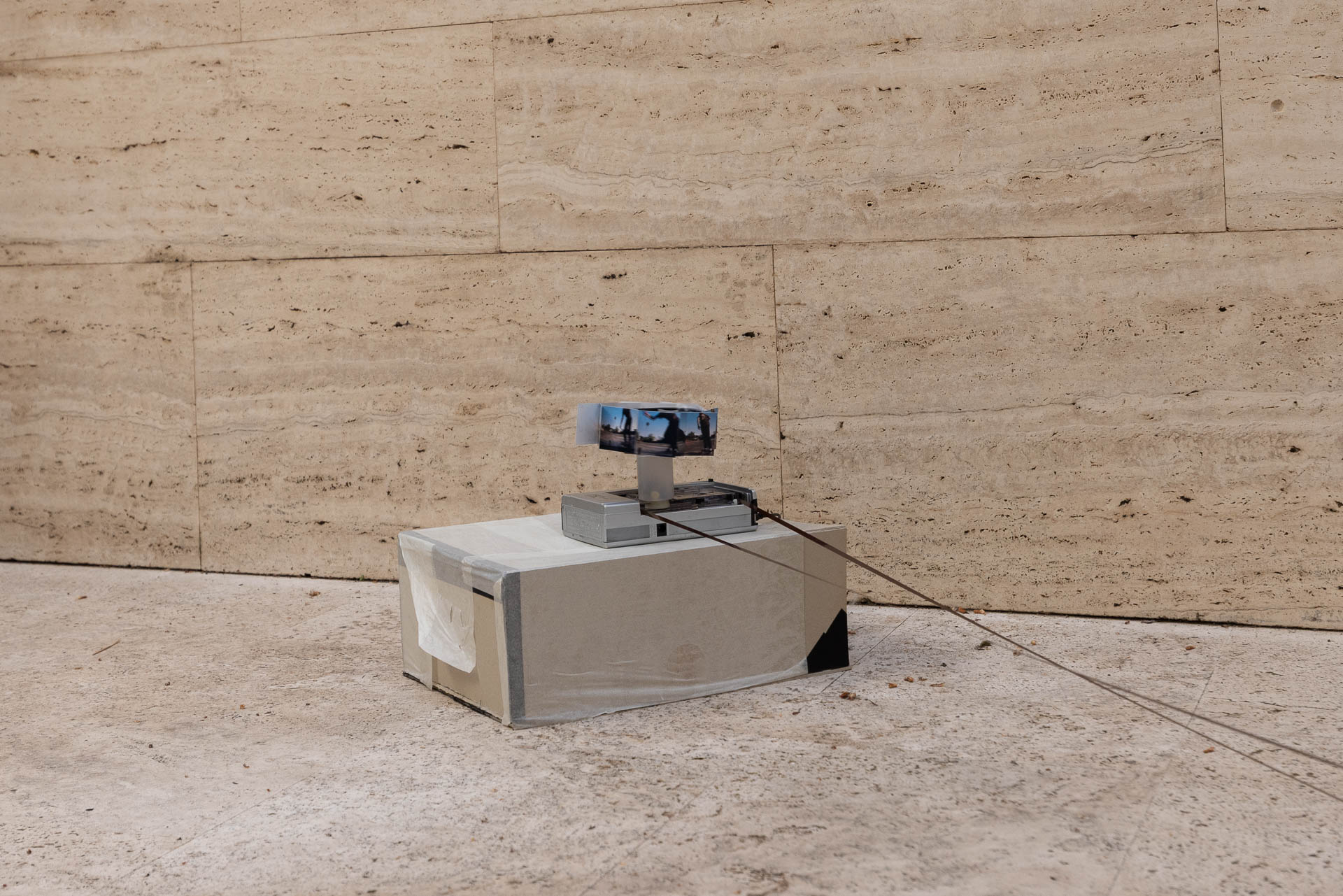
Work in progress, Istituto Svizzero, Roma, 2026 Photo: Davide Palmieri
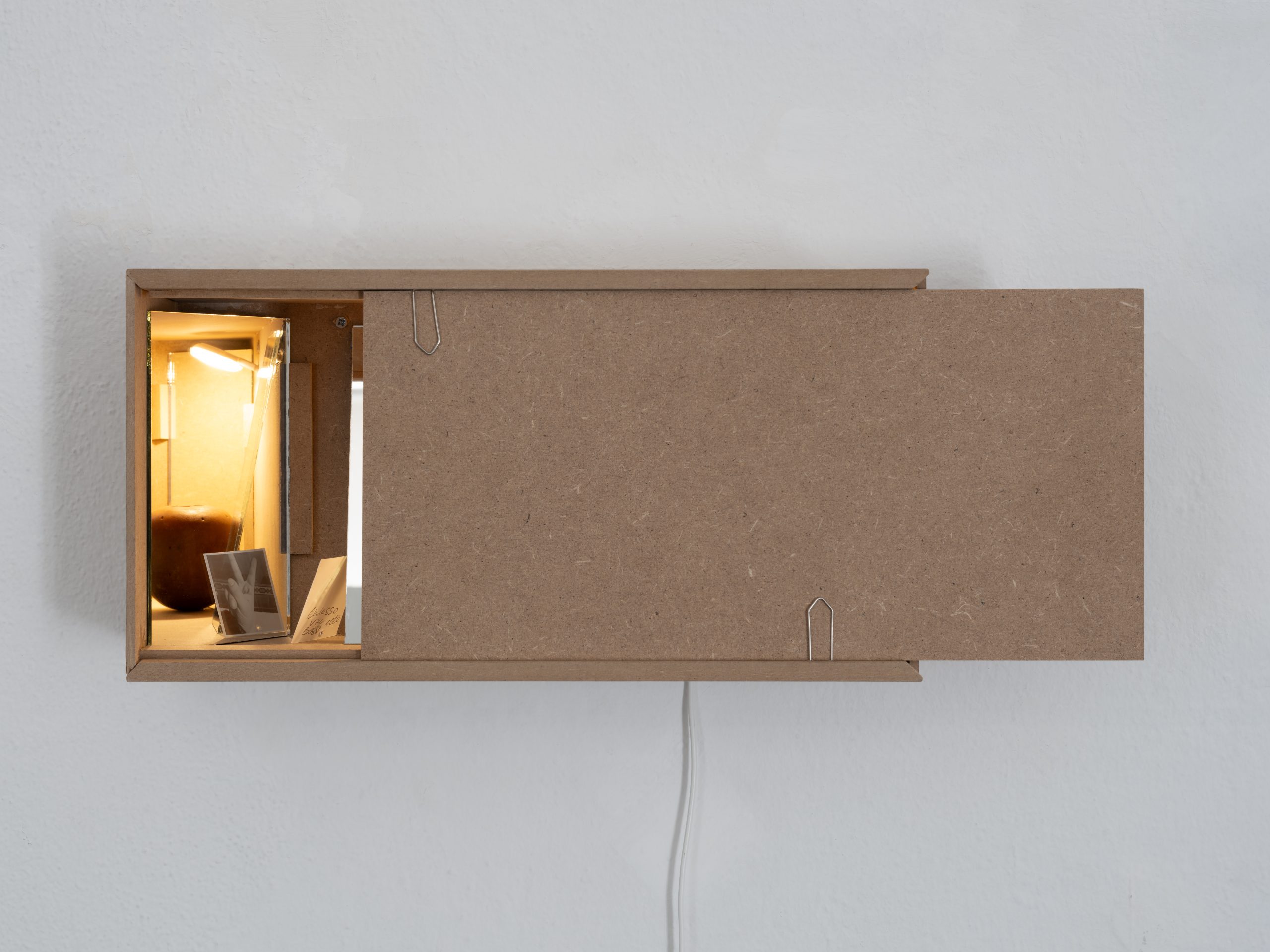
Cassetto 4, 2024, Photo: Alessandro Zambianchi
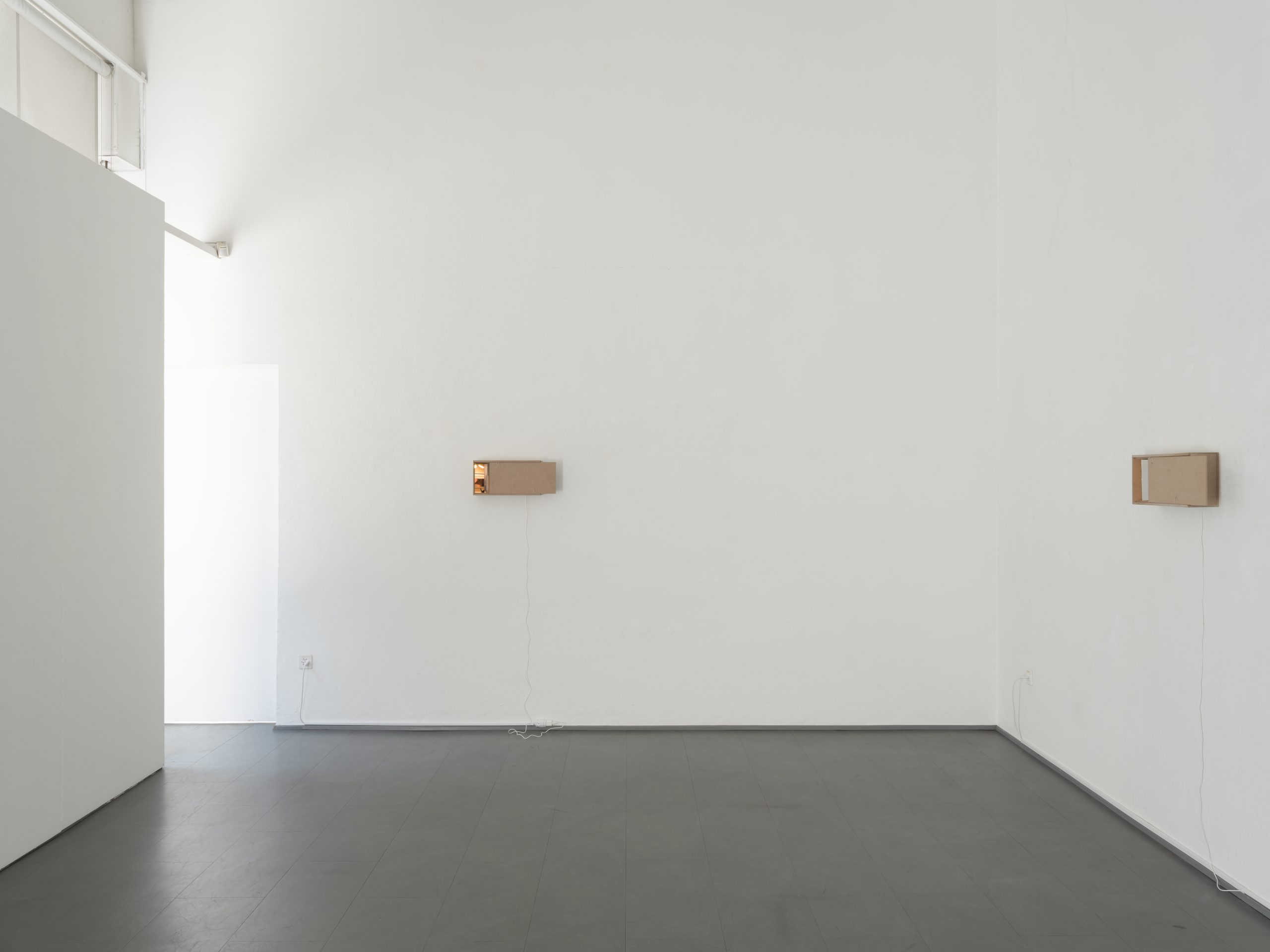
Installation view that’s entertainment, Studio Dabbeni, Lugano, 2024 Photo: Alessandro Zambianchi
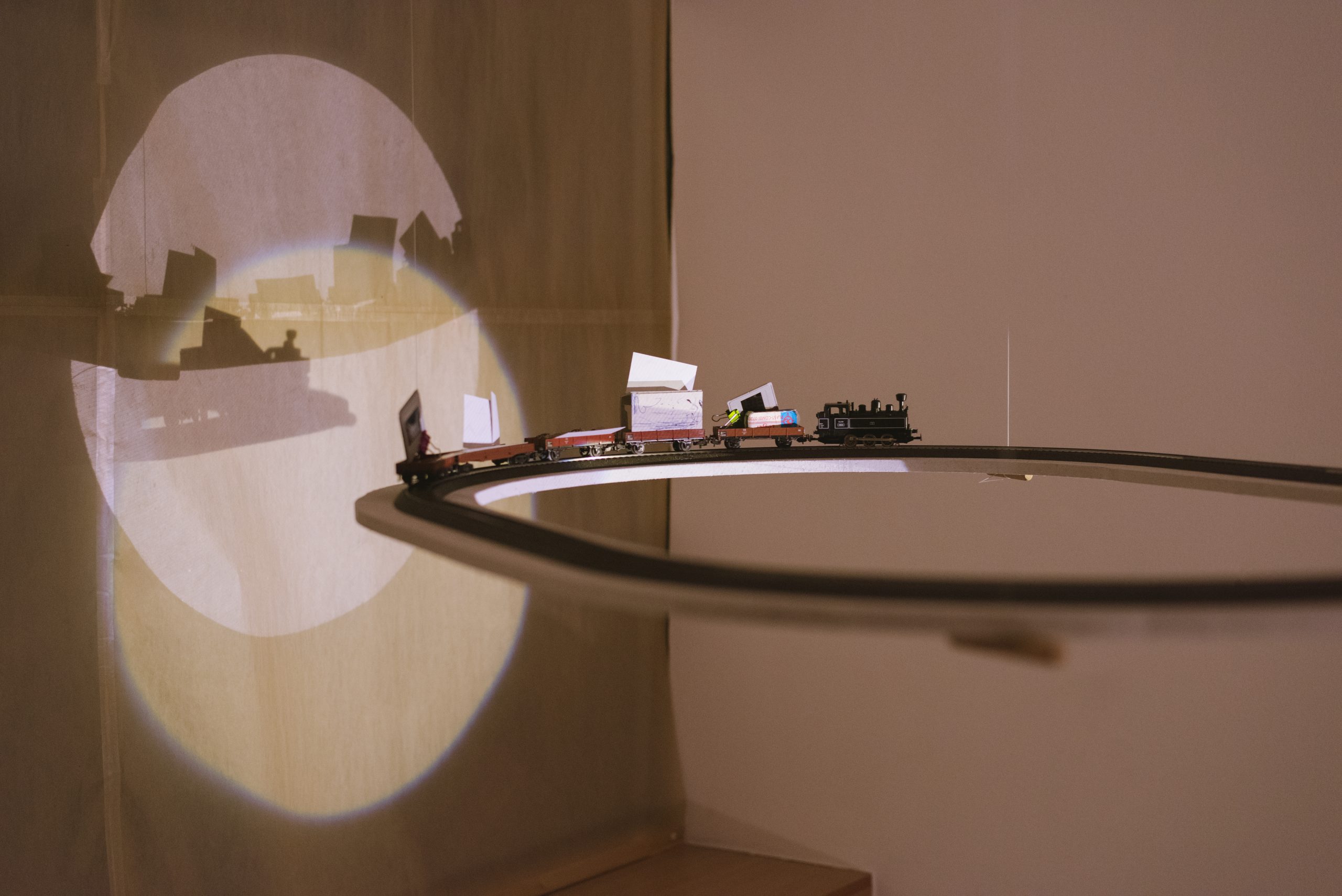
All’entrata dell’occhio, Spazio Lampo, Chiasso, 2025 Photo: Sarah Mathon
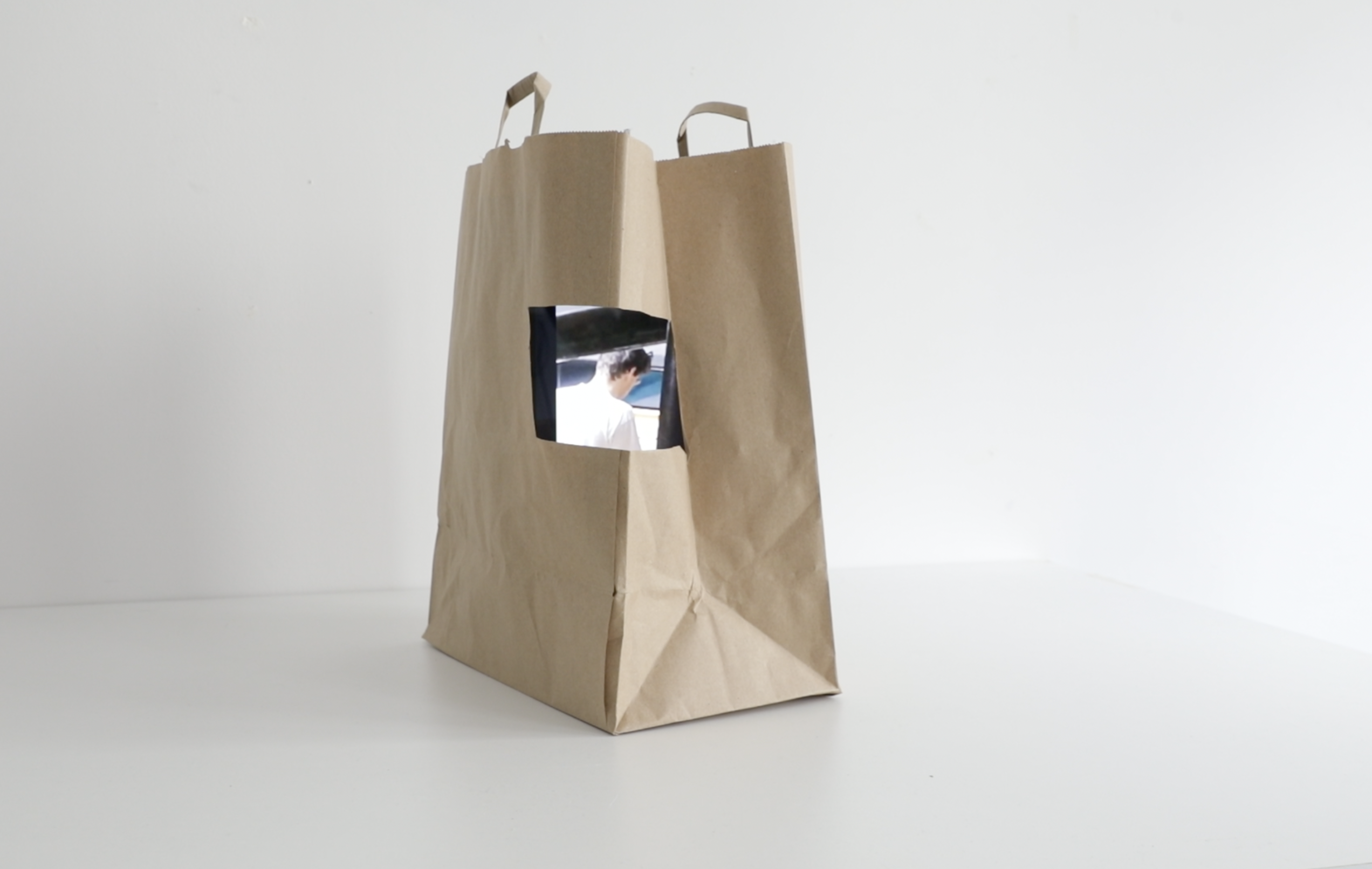
Paper Bag, 2023
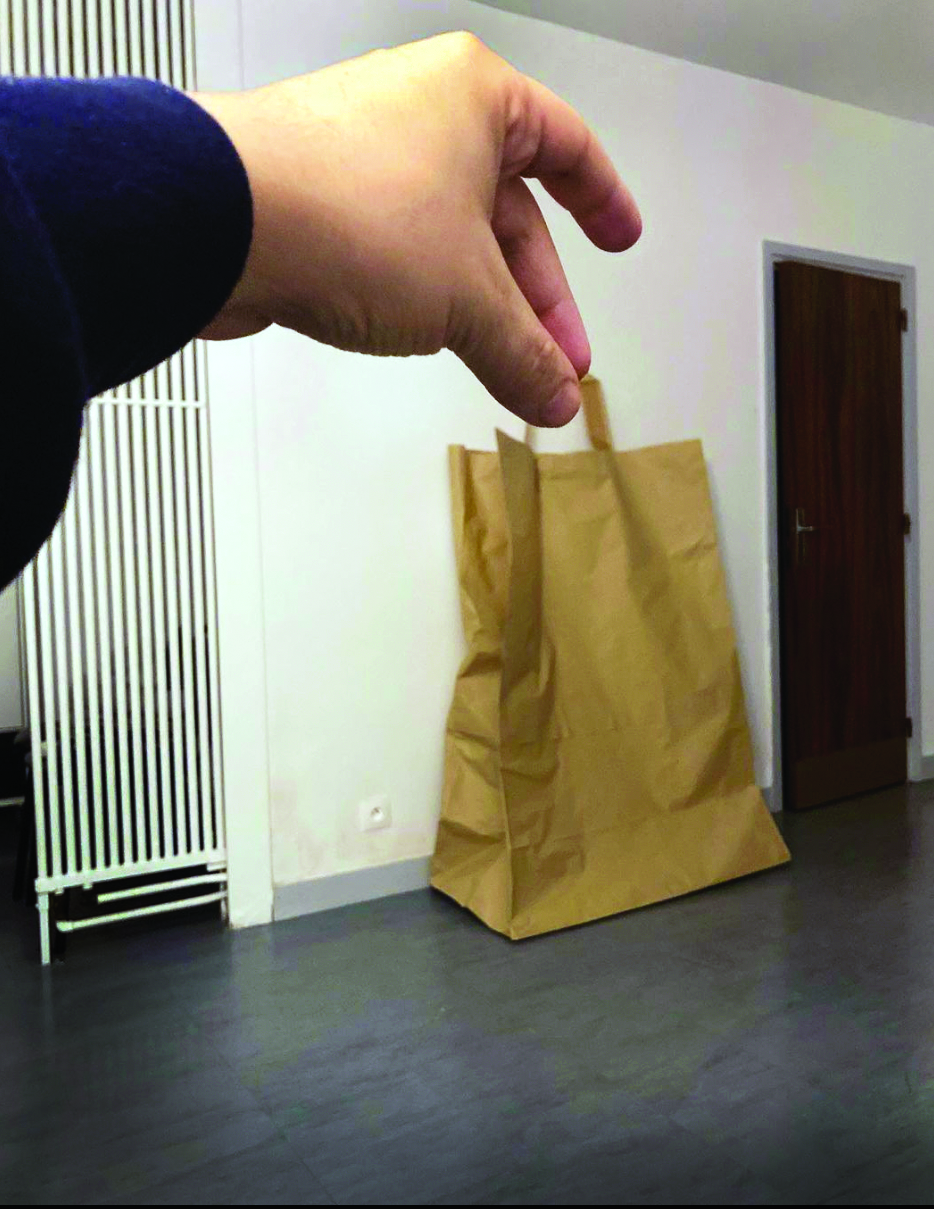
Paper Bag, Cité Internationale des Arts, Paris, 2023
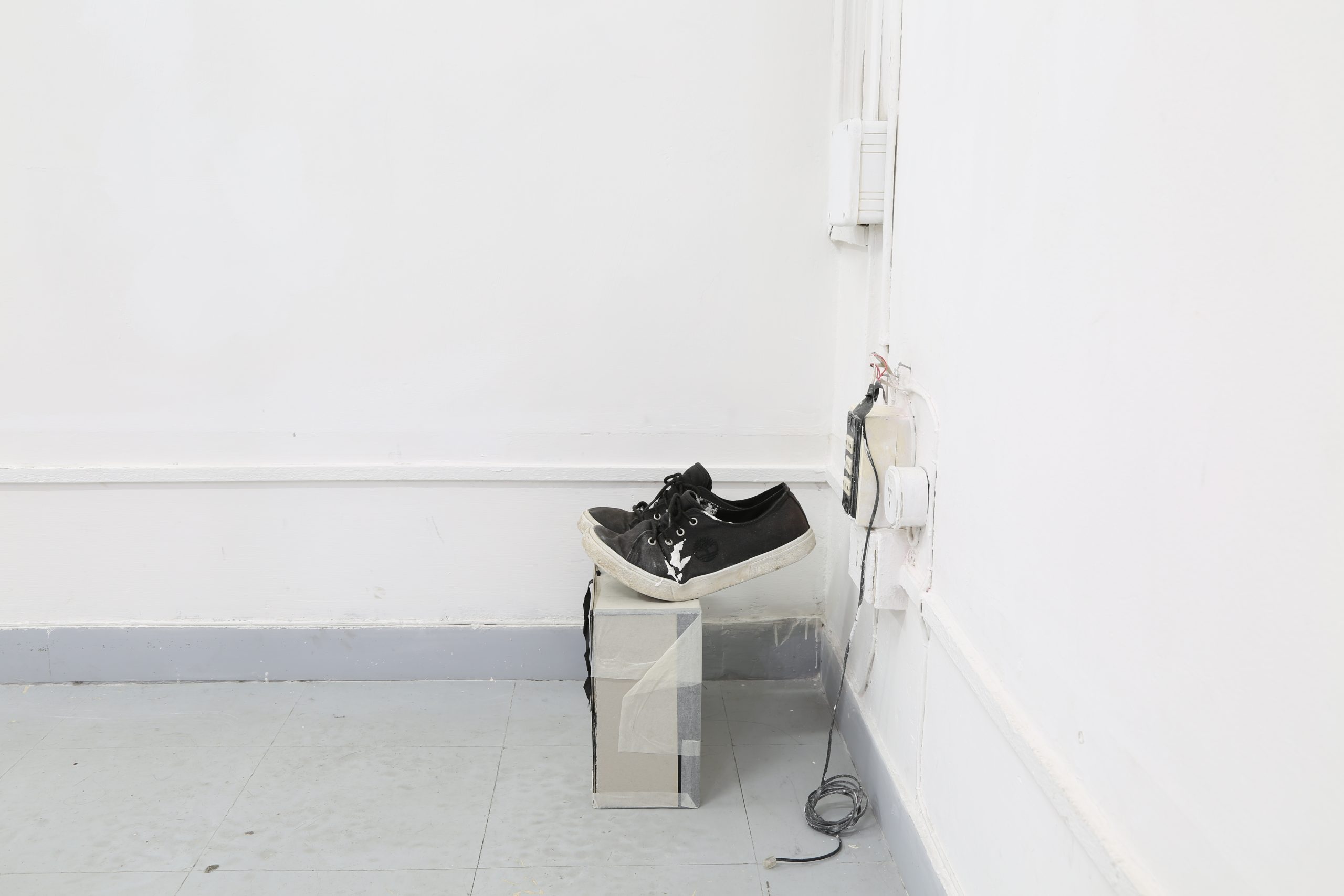
Scarpe, gesso e titubanza, Lateral, Roma, 2026 Photo: Jacopo Rinaldi