From Mimesis to Machine
Innovation series
Via Liguria 20, Roma
H10:00-21:00
Innovation series
Via Liguria 20, Roma
H10:00-21:00
From Mimesis to Machine: AI and the Evolution of Artistic Creation
As part of the Innovation Series, in collaboration with HEAD – Genève
The event will be held in English
REGISTER HERE TO ATTEND IN PERSON
REGISTER HERE TO ATTEND ONLINE
As artificial intelligence becomes increasingly integrated into artistic practice, it challenges long-established ideas of creativity, originality, and authorship. From generative images and texts to interactive installations, AI reshapes not only how art is made, but also how it is taught and understood. This shift raises urgent questions: What does it mean to create in the age of generative machines? How is creativity redefined when the artist works in dialogue with code, datasets, and algorithms? And how can educational institutions respond critically to these transformations?
While often seen as a rupture from tradition, AI-generated art is deeply entangled with historical artistic practices. This event explores the continuity between contemporary generative systems and earlier modes of artistic production grounded in imitation, variation, and transformation – principles at the heart of the classical canon. Like Renaissance artists who learned by copying and adapting established forms, today’s AI systems generate new content by recombining existing material, reflecting rather than rejecting historical ideas of how art evolves.
At the same time, this continuity prompts fundamental questions: Can AI-driven creativity move beyond imitation and meaningfully contribute to artistic evolution? How do we ensure it fosters innovation rather than reinforcing stylistic stagnation? How can artists use AI to support intuition and critical engagement? How does AI’s training data shape the aesthetic biases it perpetuates – and how can we ensure a diversity of references and perspectives in creative education? If precedent in architecture and design reflects history and tradition, and if human creators engage critically with their sources while AI cannot, what role could AI play in shaping the future of artistic discourse?
From Mimesis to Machine brings together artists, designers, historians, and educators for a day of conversations, workshops, and performances at Istituto Svizzero. The programme investigates how machine intelligence is reshaping our relationship to images, tradition, and knowledge, and how artistic education can respond critically and creatively to these changes.
PROGRAMME:
H10:00-10:30 Welcome Coffee and Institutional Greetings
Ilyas Azouzi (Head of Science, Research, and Innovation at Istituto Svizzero)
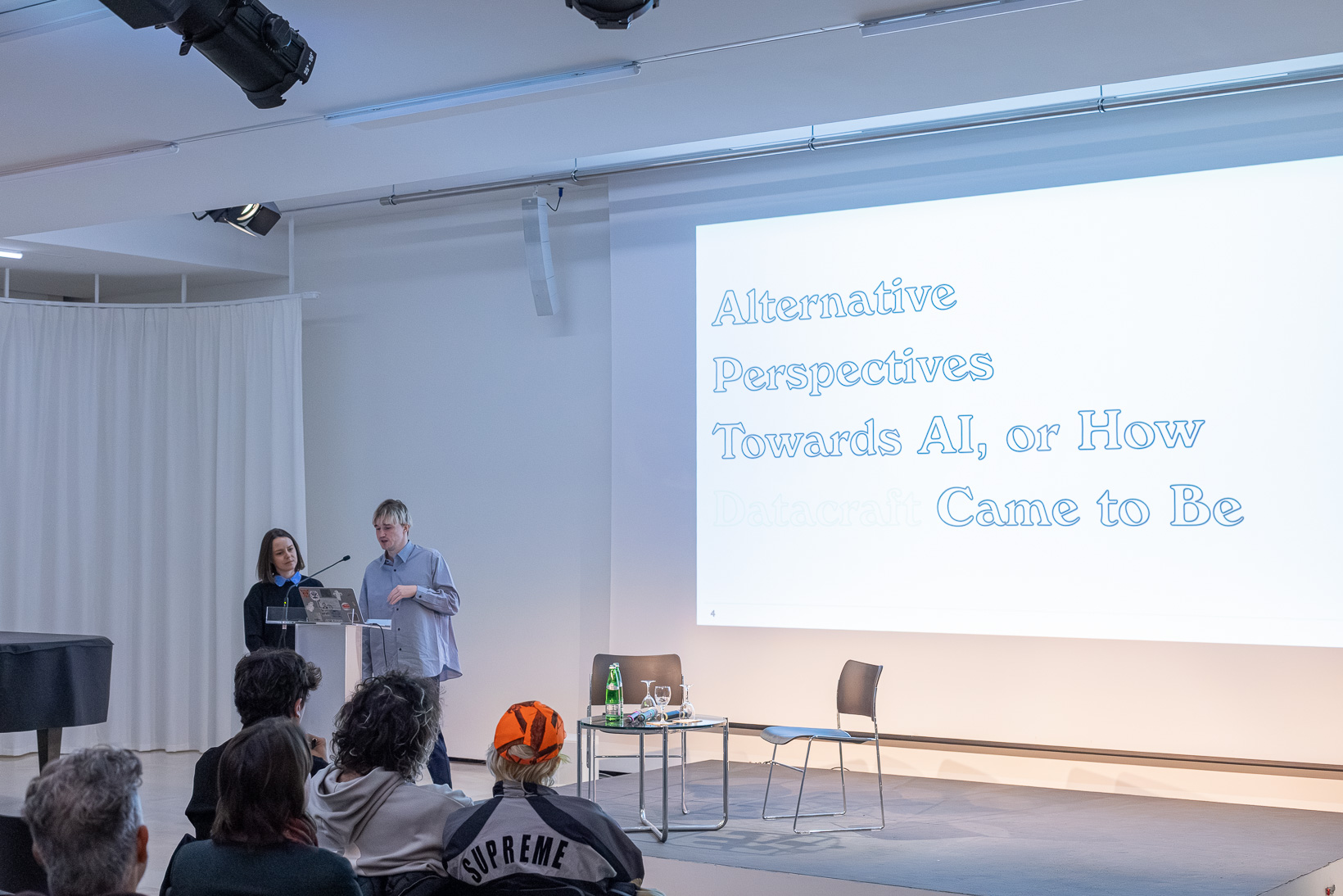
H10:30-12:30 Datacraft. Rethinking Machine Learning for Art and Design
Workshop by Alexia Mathieu and Vytas Jankauskas (HEAD – Genève)
Datacraft is a research and creation project led by the Media Design Master’s programme and the Digital Pool at HEAD – Genève, with the support of HES-SO Genève. It explores new creative approaches through the construction of personalised datasets and the training of generative models for artistic and design practices. The presentation by the Datacraft team will be followed by a short workshop with Matteo Loglio (oio studio), who will share the recipe he developed for the project, an opportunity to learn how to curate a small dataset and train a playful model.
H12:30-13:30 Break
H13:30-15:30 Teaching Creativity in the Age of Algorithms
Panel discussion and presentations:
Alexia Mathieu and Douglas Stanley (HEAD – Genève)
Christopher Salter (ZHdK)
Gianna Angelini (AANT)
Riccardo Baccani (NABA)
Moderation:
Adrian Notz (ETH Zurich)
H15:30-16:00 Coffee Break
H16:00-16:45 Playable Cinema
Workshop by Douglas Stanley and Faust Perillaud (HEAD – Genève)
Playable Cinema is a research project exploring how artificial intelligence can ride the invisible frontier between cinema history and interactive gameplay. Using machine learning to analyze hundreds of Westerns, it constructs a generative database where fragments of film history and the streams of live gameplay bleed into one another; where the joystick becomes an editing tool for an infinite Western fever dream looping through the ghosts of cinematic history.
H16:45-18:15 Machine Visual Culture: Recombination and Canon in Art History
Panel presentations and discussion:
Leonardo Impett (Biblioteca Hertziana, Cambridge University)
From Visual Culture to Tensor Culture
Stephanie Santschi (University of Zurich)
Making Boundaries Visible: AI as Critical Tool in Japanese Visual Studies
Moderation:
Valentine Bernasconi (University of Bologna)
H18:15-18:30 Break
H18:30-19:15 Creativity: From Dada to AI
Keynote by Adrian Notz (ETH Zurich)
H19:15-20:00 Aperitivo
H20:00 Music and AI performance by Le Slie’s
With Fabrizio di Salvo, Roberto Maqueda, with Anna Wszeborowska (University of the Arts London)
Le Slie’s represents a newly invented instrument, conceptually grounded in the technical principles of the Leslie speaker and the new collaborative composition by Fabrizio Di Salvo and Roberto Maqueda, with the aim advancing compositional interactions through the integration of AI.
Gianna Angelini is the Scientific Director and Head of International Relations at the Accademia delle Arti e Nuove Tecnologie (AANT) in Rome. She holds a PhD in Cultural Studies from Germany and has conducted postdoctoral research in the United Kingdom in the fields of art and multimedia. Since 2005, she has taught subjects related to visual communication, including semiotics of audiovisual texts, perception, and aesthetics. She has published two monographs and several articles in Italian and international journals. Institutionally, she has served, among other roles, as Vice President of the Italian Association of Professional Advertisers (TP), and in 2015 she founded Cr.A.Sh, an association for social promotion that connects art with local development.
Riccardo Baccani is a lecturer with extensive experience in Graphic Design and Creative Technologies. From 2017 to 2022, he worked as an Academic Specialist in the Graphic Design and Art Direction area at NABA, Nuova Accademia di Belle Arti. Currently, he is a full-time lecturer specializing in Computer Graphics, Motion Graphics, 3D Animation and VFX, and Generative AI for Creative Productions – a course developed following three years of research, leading to its formal introduction into the academy in 2023–24 academic year. In addition to his didactic-methodological approach in both Media Design and Graphics, his professional role focuses on integrating emerging technologies with visualization techniques in design practices. From 2024 he covers the role of coordinator for a specialized Applied Arts division for interdisciplinary R&D activities in the field of generative AI for design education. See project landing page at X-Lab (NABA Cross-Lab).
Valentine Bernasconi is a postdoctoral researcher at the University of Bologna, working at the Virtual and Augmented Reality Lab. Thanks to her multidisciplinary background in computer science, art history, and multimedia design, her work brings together artistic, historical, and computational approaches to the study of digital images. More specifically, her research focuses on the use of new technologies to reveal both communicative dimensions and hidden compositional patterns in artworks. As part of her artistic practice, she has collaborated on various exhibitions at the Museum für Gestaltung, the Jeu de Paume, and the Helsinki Biennial. She holds an MEng in Digital Humanities from EPFL and a PhD from the University of Zurich, where she was a doctoral fellow in the Digital Visual Studies group. Her dissertation, successfully defended in July 2024, examined the computational analysis of hands and gestures in early modern paintings. From 2023 to 2024, Valentine was a research fellow at the Swiss Institute in Rome and a visiting academic researcher at the Bibliotheca Hertziana.
Fabrizio Di Salvo grew up in Baselland, his works focus on the overcoming of essentialist and anthropocentric notions of being, negotiating the question of where the boundary between human and non-human lies and, above all, where these boundaries dissolve. In the intertwining of biological and technological contexts, his artistic practice of sonic art seeks to create an intimate space of understanding. His works have been shown at venues such as Kunsthalle Bern, Kunsthaus Pasquart Biel, Kunstmuseum La Chaux-de-Fonds, Museum der Kulturen Basel, Landesmuseum Zürich, Kunsthalle Winterthur, Milano Musica, Wien Modern, Ars Electronica, Festival Sonica Glasgow, SPOR-Festival Copenhagen, Blooming Festival Italy, Theater Roxy Birsfelden, Dampfzentrale Bern, Festival Klang-Basel, etc.
Leonardo Impett is Research Group Leader at the Bibliotheca Hertziana, Assistant Professor in Digital Humanities at the Faculty of English, University of Cambridge, and Bye-Fellow in Digital Humanities at Selwyn College, Cambridge. His research focuses on crossing AI (Artificial Intelligence) approaches to art history with art-historical approaches to AI, particularly examining bias and visual ideology in AI from the perspective of art history and visual studies. Alongside his research in digital art history, he frequently works with machine learning in arts and culture, including for the Liverpool Biennial, the Royal Opera House, and the Whitney Museum of American Art. Leonardo has a background in information engineering and machine learning, having worked or studied at the Cambridge Machine Learning Lab, the Cambridge Computer Lab’s Rainbow Group, and Microsoft Research Cairo; he was previously Assistant Professor of Computer Science at Durham University. His PhD (at EPFL) focused on the use of computer vision for the distant reading of the history of art. In 2018, Leonardo was Digital Humanities Fellow at Villa I Tatti – the Harvard University Center for Italian Renaissance Studies; from 2018 to 2020, he was Digital Humanities Scientist at the Bibliotheca Hertziana.
Vytas Jankauskas is the Head of Digital Pool at HEAD–Genève (Geneva University of Art and Design) and leads interdisciplinary social innovation programmes at the Innovation Lab of La Plateforme in Marseille. Vytas Jankauskas is also a media artist specializing in connected objects and artificial intelligence. His practice critically examines how technology shapes mundane spaces. Vytas’ work has been showcased at notable venues including Medialab Matadero, V&A Digital Design Weekend, Tate Modern Late Exchange, CCCB (with Superflux), Chroniques Biennale, Chronus Art Center, Salone Internazionale del Mobile, ISEA, and Cité du Design St. Étienne, among others.
Coming from percussion, Roberto Maqueda identifies himself as an heterodox artist interested in avant-garde creation connected to electronic worlds. He has been presented at SONICA, SPOR Festival, Manifeste or MaerzMusik. Some crucial influences have been Fred Frith, Steven Schick, Christian Dierstein or Håkon Stene. He is based in Basel (CH). He has performed concerts all around Europe, including several tours in America and Asia. Besides his first album AMOEBA (reConvert + Manassero), at the moment he is working on new solo music that will be out in near future. His main projects in the last years have been reConvert, y-band, and the artistic Co-Direction of EXIT Festival (Uruguay). Most recently he has become Artistic Co-Director of FOG (Festival offener Genres), a creative hub in Basel. He was awarded the Young Creation Award 2017 of INJUVE (Spain). Together with Jennifer Torrence, they develop 10staements.com, a reflection on collaborative practices.
Alexia Mathieu is an assistant professor and head of the Master’s programme in Media Design at the Geneva University of Art and Design (HEAD – Genève). Her research focuses on user-centred methods for creating interactive devices and new narrative forms. She built her career in design agencies across San Francisco, Boulder, and London, where she applied future-oriented design approaches to real-world contexts. She holds a diploma in Textile Design from La Cambre (Brussels) and a Master’s in Material Futures from Central Saint Martins, University of the Arts London (UAL). Her current work explores interactive storytelling, digital fashion, and the impact of artificial intelligence, especially machine learning, on contemporary design practices.
Adrian Christopher Notz is an independent curator and lecturer based in Zurich. He studied time-based media and Fine Arts at the University of the Arts Bremen and Theory of Art and Design at the Zurich University of the Arts. In 2024, he co-curated the AAA Experiments in Kunsthalle Zurich and in 2023 the Art Encounters Biennial in Timișoara. He is currently lecturer at ETH Zurich, where he led the AI+Art Program at the ETH AI Center from 2021 to 2024. From 2020 to 2022, Notz served as curator at the Tichy Ocean Foundation in Zurich. Previously, he was the artistic director of Cabaret Voltaire in Zurich (2012–2019), following roles as co-director (2006–2012) and curatorial assistant (2004–2006). From 2010 to 2015, he also headed the Department of Fine Arts at the School of Design in St. Gallen. Throughout his career, Notz has organized and curated numerous exhibitions, events, conferences, and interventions, collaborating with international artists, scientists, activists, and thinkers both at Cabaret Voltaire and globally.
Faust Perillaud is an artist working at the intersection of interactive art and game design. In their practice, they emulate landscapes and imaginary species through code, while also crafting experimental consoles and custom gaming setups. They studied art at ESAAIX in France and media design at HEAD—Genève in Switzerland, developing a practice that combines electronics and programming to create installations and reactive sculptures. Their game design approach grew within the Pang-Pang Club, a collective focused on experimental game design and critical reflection on the gaming industry. They are now a member of Bestioles Studio, based in Geneva.
Simone Rebaudengo and Matteo Loglio are the founders of oio — a creative company on a quest to turn emerging technologies into an approachable, everyday and sustainable reality, for humans and beyond. It’s a small team pushing for an impact that outweighs their footprint, helping big companies, small startups and cultural institutions to shape products and tools for a less-boring future. Some of their collaborations include YouTube, IKEA, Google, SPACE10, the Museum of the Future, and Samsung among others.
Christopher Salter is currently director of the Immersive Arts Space (IAS) at ZHdK and an active artist. Prior to this, he was Chair of New Media, Technology and the Senses at Concordia University, as well as co-director of the Hexagram Network for Research and Creation. He has authored three monographs on the arts and digital technologies and has extensive lecturing experience in higher education. As part of the continuing education programme, he is responsible for the module on the history, philosophy, and ethics of AI.
Stephanie Santschi is Postdoctoral Fellow at the Chair of East Asian Art History, Department of Art History at the University of Zurich, specializing in Digital Humanities and Japanese art history. In her research and teaching, she investigates how images create and communicate knowledge, with focus on Japanese print culture, digital methodologies, and participatory infrastructures for visual research. She is PI of the citizen science platform Drawing from the Crowd for spatial analysis of Japanese historical images and develops pedagogical frameworks for computational technologies integration in Humanities education. Her dissertation (University of Zurich, 2023) examined Hokusai’s early painting manuals; she holds an M.A. in Museum Studies (University of East Anglia, 2016) and was a Nippon Foundation Fellow at Stanford IUC in Yokohama (2020). Previous professional experience includes developing semantic research platforms at the British Museum and digital curation projects at the University of Zurich.
Douglas Edric Stanley teaches Algorithmic Design and Playable Media in the Media Design Master of the Geneva University of Art and Design (HEAD). In 1998 Douglas founded the Atelier Hypermédia at École supérieure d’art d’Aix-en-Provence, an atelier dedicated to the exploration of algorithms and code as artistic materials, with a particular emphasis on the use of play in the exploration of emerging forms. He has organised numerous workshops related to creative programming for various non-profits, museums, universities and art schools. As an artist and curator, he has organised or participated in many international exhibitions related to digital art.
Anna Wszeborowska is an independent software developer and an academic researcher focusing on interactive real-time systems for music and audio. Her research focuses on exploring strategies for aiding musical self-expression with artificial intelligence. Anna draws upon over a decade of practical experience in the creative industry. She has held the role of Technical Principal at the Berlin-based company Ableton, working on software and hardware products which have become industry standards for performing electronic music on stage. Since 2022 she has been associated with University of the Arts London, where she has worked as a researcher on a project promoting ethical use of AI in creative music practice, funded by Responsible AI UK. In parallel, Anna has been pursuing a part-time PhD in the same area. Anna regularly shares her research and know-how at major conferences for software developers, often as a keynote speaker. As a passionate educator, she has been involved with multiple mentoring initiatives for groups underrepresented in tech, striving to empower marginalised communities and help them advance in their practice.
© Davide Palmieri
© Davide Palmieri
© Davide Palmieri
© Davide Palmieri
© Davide Palmieri
© Davide Palmieri
© Davide Palmieri
© Davide Palmieri
© Davide Palmieri
© Davide Palmieri
© Davide Palmieri
© Davide Palmieri
© Davide Palmieri
© Davide Palmieri
© Davide Palmieri
© Davide Palmieri
© Davide Palmieri