A temporary history
H18:00-20:30
H18:00-20:30
The event will be held in English
A temporary history
Film screening and roundtable on the role and future of UNRWA (United Nations Relief and Works Agency for Palestine Refugees in the Near East)
The evening will open with the screening of UNRWA, 75 ans d’une histoire provisoire, a Swiss documentary exploring the complex history of the Agency. In the presence of the film directors and an UNRWA representative, the discussion will examine the present and future of the world’s longest unresolved refugee crisis, focusing on the Agency’s essential role and the critical services it provides to millions of Palestine refugees across the region.
With: Lyana Saleh and Nicolas Wadimoff (Film Directors), Tamara Alrifai (Director of External Relations and Communications UNRWA), Lorenzo Marsili (Director Berggruen Institute)
Moderation: Azzurra Meringolo (Radio Rai)
PROGRAMME:
H18:00 – Screening of the film UNRWA, 75 ans d’une histoire provisoire, 70′
H19:30 – Roundtable and Q&A with directors Nicolas Wadimoff (In person), Lyana Saleh (Online), Tamara Alrifai (Director of External Relations and Communications, UNRWA) and Lorenzo Marsili (Director, Berggruen Institute). Moderation: Azzurra Meringolo (Radio Rai).
UNRWA : 75 ANS D’UNE HISTOIRE PROVISOIRE
2025, 70’, O.V with English subtitles
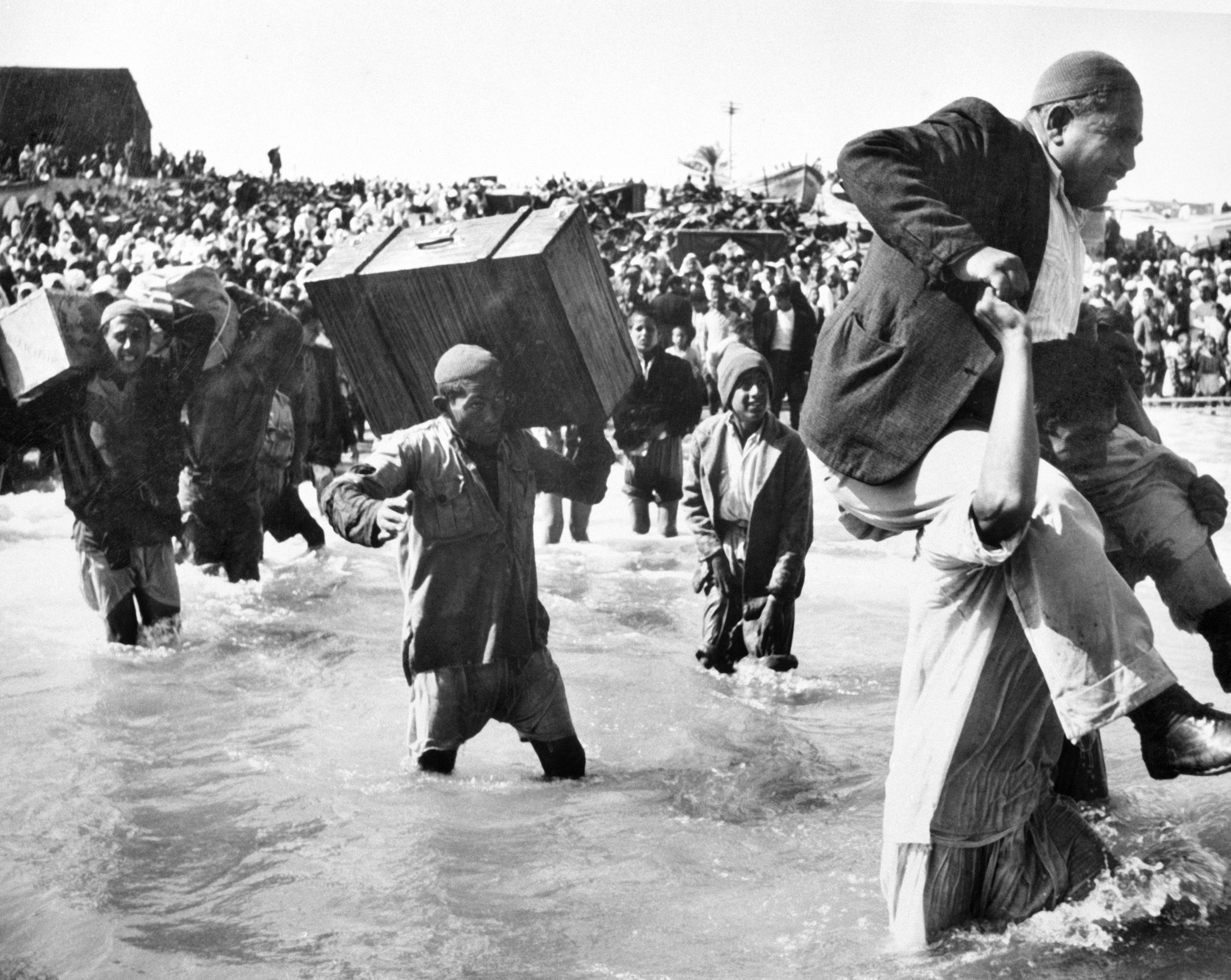
Created in 1949 by the United Nations General Assembly, UNRWA (United Nations Relief and Works Agency for Palestine Refugees in the Near East) was established to meet the essential needs of Palestinian refugees: health, education, humanitarian aid, and social services. Originally conceived as a temporary structure, the agency has nevertheless endured for 75 years, weathering wars and successive crises, and becoming deeply rooted in the social fabric of Palestinian life.
Over the decades, UNRWA has become an indispensable pillar for millions of Palestinian refugees, contributing not only to their subsistence but also to the preservation of their identity. However, the agency faces multiple pressures and criticisms: some believe it reinforces a prolonged refugee status, others voice more serious allegations, while many consider it primarily affected by misinformation and debates over international law.
After October 7, UNRWA has been confronting the greatest crisis in its history, to the point that the prospect of its outright disappearance is looming. What would be the consequences for the Palestinian people if the agency were to cease its activities? This documentary offers a cross-perspective from experts, historians, and insiders to shed light on the history and future of an organisation whose fate remains tied to that of the Palestinian refugees.
Lyana Saleh is a journalist, director, and cultural columnist on France 24. Her first short film, A Ball and a Coloring Box (2004), won the Best Student Film Award at the New York International Independent Film Festival. After settling in France in 2005, she began her journalism career at Radio Monte Carlo Doualiya (the Arabic branch of RFI) before joining France 24 in 2009.
Between 2010 and 2015, Lyana Saleh produced several reports, notably in Libya, Palestine, Jordan, Iran, and Cuba. She also co-produced and directed several documentaries, including Un comédien dans une tragédie syrienne (2019) and Notre mémoire nous appartient (2020) by Syrian director Rami Farah — the latter winning the Human Rights Dox Award at Dokufest 2021 and the Film Prize Leipziger Ring at DOK Leipzig 2021.
She also co-directed Palestine: état second with James André, as well as Rebelle de Raqqa with Claire Billet for France 24. This last documentary won the Grand Prix at FIGRA in 2015 as well as the Audience Award at the PriMed festival in Marseille.
After studying film in Montreal, Nicolas Wadimoff presented his first short film The Bowl (1991) in Locarno. Guitarist in an alt-rock band, he cofounded L’Usine, an independent Genevan cultural centre. In 1992, he directed The Golden Gloves of Akka, the portrait of a Palestinian boxer, and in 1997, with Denis Chouinard, Wadimoff directed his first fiction Clandestins. He founded Akka Films in 2003, a production company that has accompanied, among others, many Palestinian filmmakers. Aisheen (2010), shot in Gaza, had its world premiere at the Berlinale. The Directors’ Fortnight in Cannes hosted his return to fiction with Operation Libertad (2012). Spartiates (2015), portrait of an MMA coach in the northern parts of Marseille, won the Soleure Prize, and The Apollo of Gaza (2018) opened Locarno’s Critics’ Week. After a detour in education at HEAD – Geneva (2019- 2023), he directed in 2025, with Lyana Saleh, UNRWA, 75 Years of a Temporary History.
Tamara Alrifai is the UNRWA Director of External Relations and Communications. An outreach and advocacy expert in the fields of humanitarian action and human rights, she has held positions in conflict and post-conflict contexts, as well as in diplomatic capitals, including Geneva and New York, with the United Nations, the International Committee of the Red Cross and Human Rights Watch. Ms. Alrifai is a published media contributor and regularly appears in regional and international media to comment on humanitarian and human rights issues.
Lorenzo Marsili is an activist philosopher and writer. The founder of several social enterprises including transnational NGO European Alternatives and cultural institution Fondazione Studio Rizoma, his research and political work focus on defining and promoting futures beyond the nation-state. A regular public speaker and international media commentator, he was the founding editor of the independent journal Naked Punch Review in London and Beijing. He has degrees in philosophy and sinology from the University of London, and his books include Il Terzo Spazio (Laterza, 2017), Citizens of Nowhere (Zed Books, 2018), La tua patria è il mondo intero (Laterza, 2019), and Planetary Politics (Polity Press, 2020). Occasionally, he writes plays for the theatre. He lives between Venice, Berlin, and Palermo.
Azzurra Meringolo is a correspondent with the foreign desk of Giornale Radio Rai, where she primarily covers Middle Eastern affairs. She previously served as editor-in-chief of AffarInternazionali. Holding a PhD in International Relations, she teaches Arab Media at Roma Tre University and on the Master’s in Journalism at the University of Bologna. She has contributed to national and international publications and was editor of the journal Arab Media Report. She has also presented the programme Radio 3 Mondo on Rai3.
Her doctoral thesis on Egyptian anti-Americanism was awarded the Maria Grazia Cutuli Prize. In 2013, she won the Indro Montanelli Writing Prize with I ragazzi di piazza Tahrir. Her audio documentary “Help me! I am a child, they are shooting at me.” Hind Rajab’s last phone call from Gaza received the Luchetta Prize, the Global Media Peace Award from the University of Montreal, and the Peace Audio Category Award from the Asia-Pacific Broadcasting Union. She is also the author of several podcasts for Rai Play Sound, the most recent being Le loro prigioni. Voci e cronache in presa diretta dalle carceri del Mediterraneo. She is among the founders of WIIS (Women in International Security) Italy.
Palestine refugees initially displaced to Beach camp in Gaza board boats to Lebanon or Egypt during the 1948 war. © 1948 UNRWA Photo by Hrant Nakashian