Plantation Architectures
Chapter I. Plant Histories
Chapter II. Plantation Architectures
Chapter I. Plant Histories
Chapter II. Plantation Architectures
REGISTRATION HERE TO PARTICIPATE IN PERSON 25.03.2026
REGISTRATION HERE TO PARTICIPATE IN PERSON 26.03.2026
REGISTRATION HERE TO PARTICIPATE IN PERSON 27.03.2026
REGISTRATION HERE TO PARTICIPATE ONLINE 25.03.2026
REGISTRATION HERE TO PARTICIPATE ONLINE 26.03.2026
REGISTRATION HERE TO PARTICIPATE ONLINE 27.03.2026
Plant Histories, Plantation Architectures
Two-chapter Symposium
The symposium is organised in collaboration with the research group “Voyaging Vapors: Plant Histories of Plantation Architectures”, led by Dr Will Davis (Università della Svizzera italiana), with Dr Rixt Woudstra (University of Amsterdam), Siddharta Perez (NUS Museum), Giah De los Reyes-Geronimo, and Hélène Padma De Mello (USI).
This is the second chapter of Plant Histories, Plantation Architectures: Two-Chapter Symposium following the first chapter, “Plant Histories” held at Singapore Botanic Gardens on 29–30 January 2026. Funded by the Swiss National Science Foundation, the symposium is supported by Singapore Botanic Gardens, the National Parks Board (Nparks), the National University of Singapore Museum, and the Università della Svizzera italiana.
The plantation system is a term used to describe forms of monocrop agricultural land use, of shaping land after the cultivation of single crops in climates suitable to them. Scholarly discourse in recent years has traced the historical genealogies of extraction and de-diversification of the natural world that the system, with its rapacious claims to territory over four centuries, has come to represent. From at least the seventeenth century on, the plantation system fundamentally altered how people perceived land, property, plants, people, and their environments. Artificial species flows combined with trade and commerce created a disembodied system with disastrous consequences for the ecological complexity of the world and its climate.
The recognition of this system has led to contemporary shifts in perspectives of the environment, that it is interconnected and needs diversity in order to thrive, revealing the extent to which a reimagining of existence outside of plantation logics is necessary. Conceptually, therefore, to understand the history of the plantation is also a method to understand its opposite: biological complexity and inter-species flourishing.
Architecture has had a troubled historical relationship to plantation environments. As an ordering system, dwelling device, and apparatus for synthetic plant growth, one can project a range of examples. In Europe these range from the stately residences in the British countryside of erstwhile plantation owners in the Caribbean to greenhouses for testing banana plant hybrids to tobacco auction houses in Amsterdam. Geographically removed, yet deeply intertwined are the examples in Europe’s elsewheres: coffee processing warehouses under a tropical sun, watchtowers framing their perimeter, rudimentary barracks for workers; and as counterpart, examples of living outside of or in spite of the plantation system, such as maroon communities and so-called slave gardens.
What can plants tell us about these stories, and in what ways do plant histories diversify our understanding of the plantation system and its architectures?
PROGRAMME
DAY 1 – 25.03.2026
H14:00
Introduction
Institutional Greetings: Ilyas Azouzi (Istituto Svizzero)
Voyaging Vapors: Plant Histories of Plantation Architectures
Will Davis, Rixt Woudstra, Siddharta Perez, Giah De los Reyes-Geronimo, Hélène Padma De Mello
H15:00
Session I
Chair: Will Davis (Università della Svizzera italiana)
Call it by its name: shaping a Ticinese plantation architecture in the Italian Kingdom (1887–1947)
Angela Gigliotti (Eastern Switzerland University of Applied Sciences; ETH Zürich; Syracuse University)
Fugitive Conquerors: Palms from Exotic Ornament to Ecological Actor
Francesca Frassoldati, Valentina Labriola (Politecnico di Torino; Tsinghua University)
Re/Claimed: Dredging Settler Colonial Plantations in Florida and Italy
Vyta Pivo (University of Miami)
Response: Sylvia Lavin (Princeton University)
DAY 2 – 26.03.2026
H09:30
Session II
Chair: Rixt Woudstra (University of Amsterdam)
Spatial Conversion. From the garden of the enslaved on a Bahian coffee plantation, to the villa park gardens of a Swiss bourgeois city
Denise Bertschi (Collegium Helveticum)
Unruly Plant Histories: Manoomin from the Great Lakes to the Kew Waterlily Pond
Émélie Desrochers-Turgeon (Dalhousie University)
From Sundanese Tea Plantations to World’s Fair: Local Material Culture and its Imperial Refiguration in Chicago 1893
Geraldus Martimbang (TU Munich)
Pineapple Architecture: Performing Plantation Histories in São Miguel Island
Fernando P. Ferreira; Daniel Duarte Pereira (Space Transcribers)
Response: Ilyas Azouzi (Istituto Svizzero)
H12:00
Break
H13:15
Workshop Part 1 – Residues of Touch
Giah De los Reyes-Geronimo
H14:00
Session III
Chair: Will Davis (Università della Svizzera italiana)
Plantation Architectures in Colonial Goa. The Spatial Politics of Conversion, Caste, and Extraction
Nuno Grancho (University Institute of Lisbon)
Soft Crop, Hard Labor: An Ottoman Imperial Farm and the Circulation of the American Plantation System across the Empires
Asya Ece Uzmay (Cornell University)
Sugar and coffee: two lives of the Santa Gertrudes plantation, Brazil, c. 1850 and 1900
Cecília Resende Santos (Columbia University)
Reclaiming the Smokehouse: Appropriating Colonial Architecture for Living Heritage in the Banda Islands, Indonesia
Joëlla van Donkersgoed (University of Luxembourg)
Response: Eva Schreiner (Kunsthistorisches Institut in Florenz – Max-Planck-Institut)
H16:30
Coffee Break
H17:00
Keynote Lecture – Points, Lines and Polars: How to Tether Your Plantation to the Ground
Sylvia Lavin (Princeton University)
Response: Rixt Woudstra (University of Amsterdam)
DAY 3 – 27.03.2026
H09:30
Session IV
Chair: Hélène Padma De Mello (Università della Svizzera italiana)
Sharp gradients: comparing Saint Domingue (Haiti)’s and Jamaica’s co-located spas, hothouses, hospitals and early imperial botanic gardens
Finola O’Kane (University College Dublin)
The Proefstation: Rubber Research Center, in Medan, East Sumatra in the Twentieth Century
Budi Agustono and Muhammad Rasyidin (University of Sumatera Utara, Indonesia)
Staging the Subtropics: Tsikhisdziri Limonarium and the Architecture of Citrus Monoculture
Salome Katamadze and Duccio Fantoni (Politecnico di Milano)
Thirsty plants: irrigating plantations and the architecture of water
Davide Martino (Université Libre de Bruxelles)
Response: Sascha Roesler (Università della Svizzera italiana)
H12:00
Break
H13:00
Workshop Part 2 – Residues of Touch
Giah De los Reyes-Geronimo
H13:30
Session V
Chair: Rixt Woudstra (University of Amsterdam)
Nitrogen Wonder. Cultural Film, Soil Fertility, and the Scaffolding of Optimal Growth
Ella Neumaier (École Polytechnique Fédérale de Lausanne – EPFL)
Plantation Legacies and Urban Design: Medan’s Transformation from Deli Plantations to the ‘Paris van Sumatra’
Sri Shindi Indira (Institut Sains dan Teknologi Nasional – ISTN)
The Bamboo that Made Made in Italy
Rebecca Carrai (KU Leuven)
Response: Ewan Harrison (University of Manchester)
H15:30
Coffee Break
H16:00
Closing Remarks
The event may be photographed and/or video recorded for archival, educational, and related promotional purposes. By attending this event, you are giving your consent to be photographed and/or video recorded.
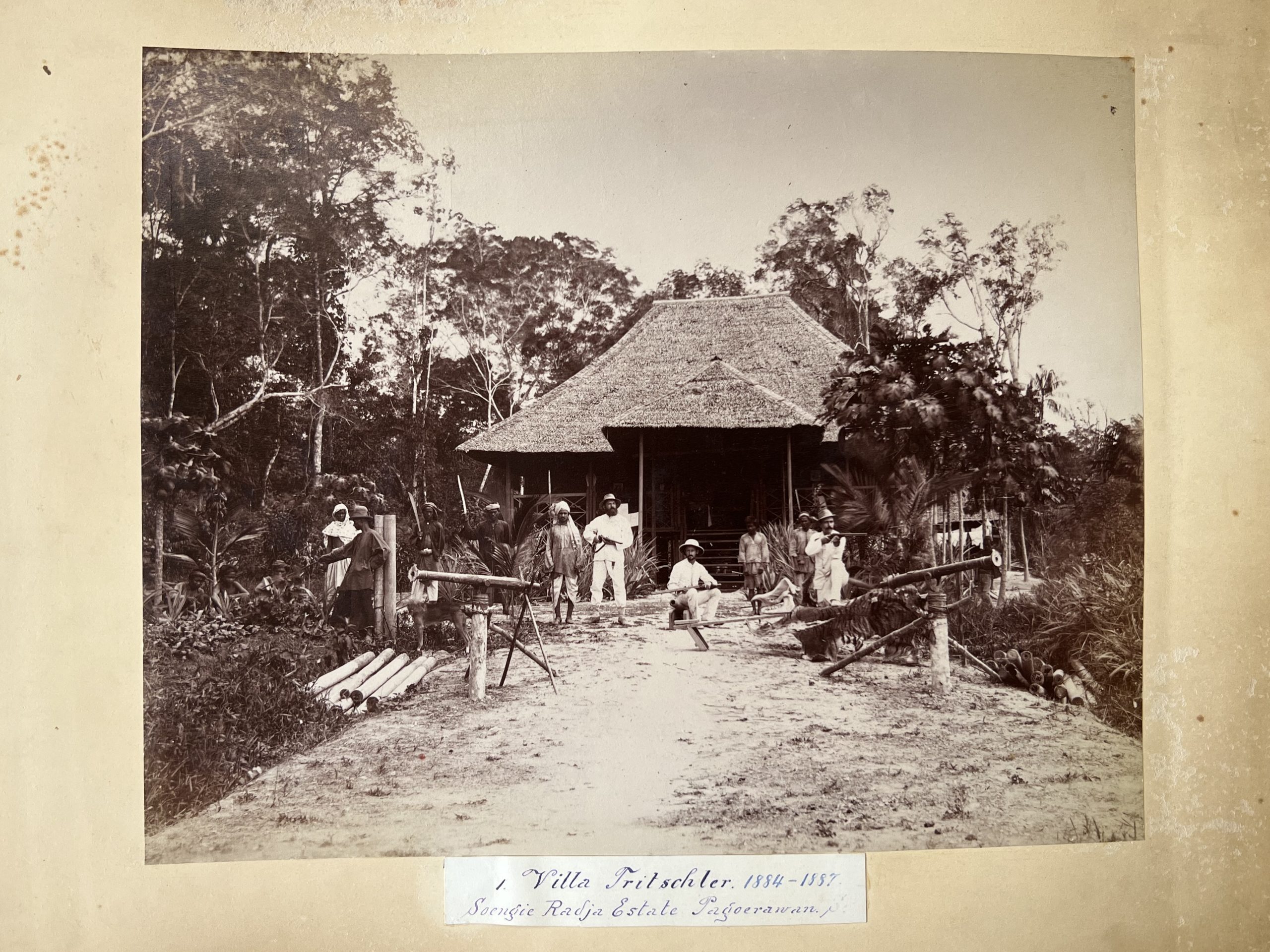
“Villa Tritschler. 1884-1887.” Reiseerinnerungen von Ferdinand Tritschler. Stadtarchiv Zürich.
View from Sibayak towards Patumbak, Sumatra 2025 (photograph by Will Davis)