Difficult Heritage
H18:00-20:30
H18:00-20:30
REGISTRATION HERE TO PARTICIPATE
Difficult Heritage. Mapping Rome’s 1930s Colonial Corridor and Its Afterlives
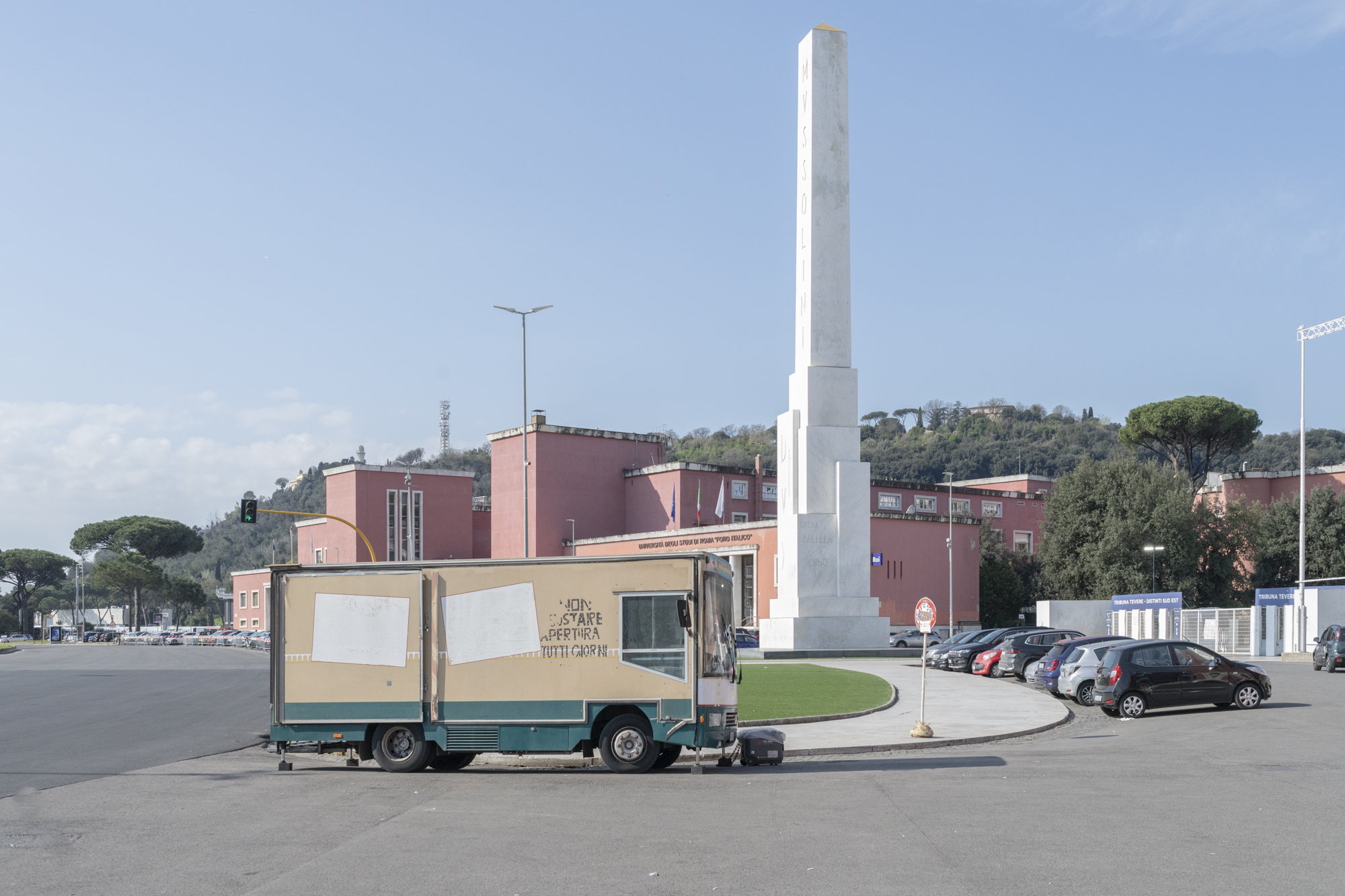
The Summer School Difficult Heritage: Mapping Rome’s 1930s Colonial Corridor and Its Afterlives is presented to the public through an exhibition that reconstructs the fascist colonial project to connect Rome to the sea, extending from the Foro Italico to Ostia through the historic centre, the EUR district, and the reclaimed territories. Videos, photographs, sound recordings, drawings, and texts examine the continuities, transformations, and erasures of this territorial apparatus within contemporary Rome.
The exhibition was developed in collaboration with the Chair of Theory of Architecture at ETH Zurich, and with the Chair of History of Architecture at Sapienza University of Rome.
PROGRAMME:
H18:00-18:30 Presentation of the Summer School and exhibition by the organisers, students, and invited guests
H18:30-19:30 Exhibition open to the public, with guided tours led by the organisers and students
BIOGRAPHIES:
Giorgio Azzariti is an architect, researcher and lecturer at ETH Zurich. His research focuses on twentieth-century architecture, with particular attention to the relationship between architecture, state formation, infrastructure and political imaginaries. He holds a PhD from the Chair of Architectural Theory at ETH Zurich. He is a co-founder of VELIA.
Edoardo Cappella is an architect and lecturer at the Pantheon Institute in Rome. His work focuses on contemporary architectural practice, urban transformation and the adaptive reuse of existing buildings. He is a co-founder of VELIA.
Paolo Catrambone is an architect and teaching assistant at the Accademia di Architettura of USI in Mendrisio. His work combines professional practice, teaching and research. He is a co-founder of Ortus.
Davide Curatola Soprana is a photographer and media artist. His work focuses on architecture, landscape and processes of social and territorial transformation. Through photography and moving images, he develops visual investigations into the relationships between space, memory and contemporary forms of inhabitation.
Maria Clara Ghia is an architect, architectural historian and Associate Professor at Sapienza University of Rome. Her work focuses on twentieth-century and contemporary architecture, with particular attention to the post-war period and the relationships between ethics, design, art and architecture.
Emma Kaufmann LaDuc is an architect, landscape architect and researcher at ETH Zurich. She teaches at the Chair of Affective Architectures and leads experimental summer schools on landscape, urbanism and contested territories at the Architectural Association in London. She is the founder of PASS, a spatial practice that reflects through resilient systems and intervenes through collaborative actions.
Curatorial support by Ginevra Ludovici – an independent curator and researcher at the IMT School for Advanced Studies Lucca – whose work focuses on difficult heritage, decolonial practices and independent art institutions.
With the participation of Martina Aidé Garcia, Giorgia Armario, Esin Ataker, Monica Ciobotar, Matteo De Petris, Elisa Frondizi, Claudia Gianni, Marina Kottler, Elisaveta Kriman, Gabriele Nunzio Limitone, Seraina Lutta, Semaya Mehret, Giulia Roberta Negri, Antonia Helene Nolte, Maximilian Sinn, Silvia Susanna, Gilda Varini, Nan Zhang.
The entrance to the Foro Italico, with the obelisk dedicated to Mussolini in the background (Photo: Davide Curatola Soprana, 2026).