Eschatology and Care
14.04.2026 H09:00-18:00
15.04.2026 H09:00-18:00
14.04.2026 H09:00-18:00
15.04.2026 H09:00-18:00
REGISTER HERE TO PARTICIPATE 14.04.2026
REGISTER HERE TO PARTICIPATE 15.04.2026
Eschatology and Care.
The Manuscripts of the Wellcome Scribe in Interdisciplinary Perspectives
The conference is organised in collaboration with the University of Bern and the Università degli studi di Cassino e del Lazio meridionale.
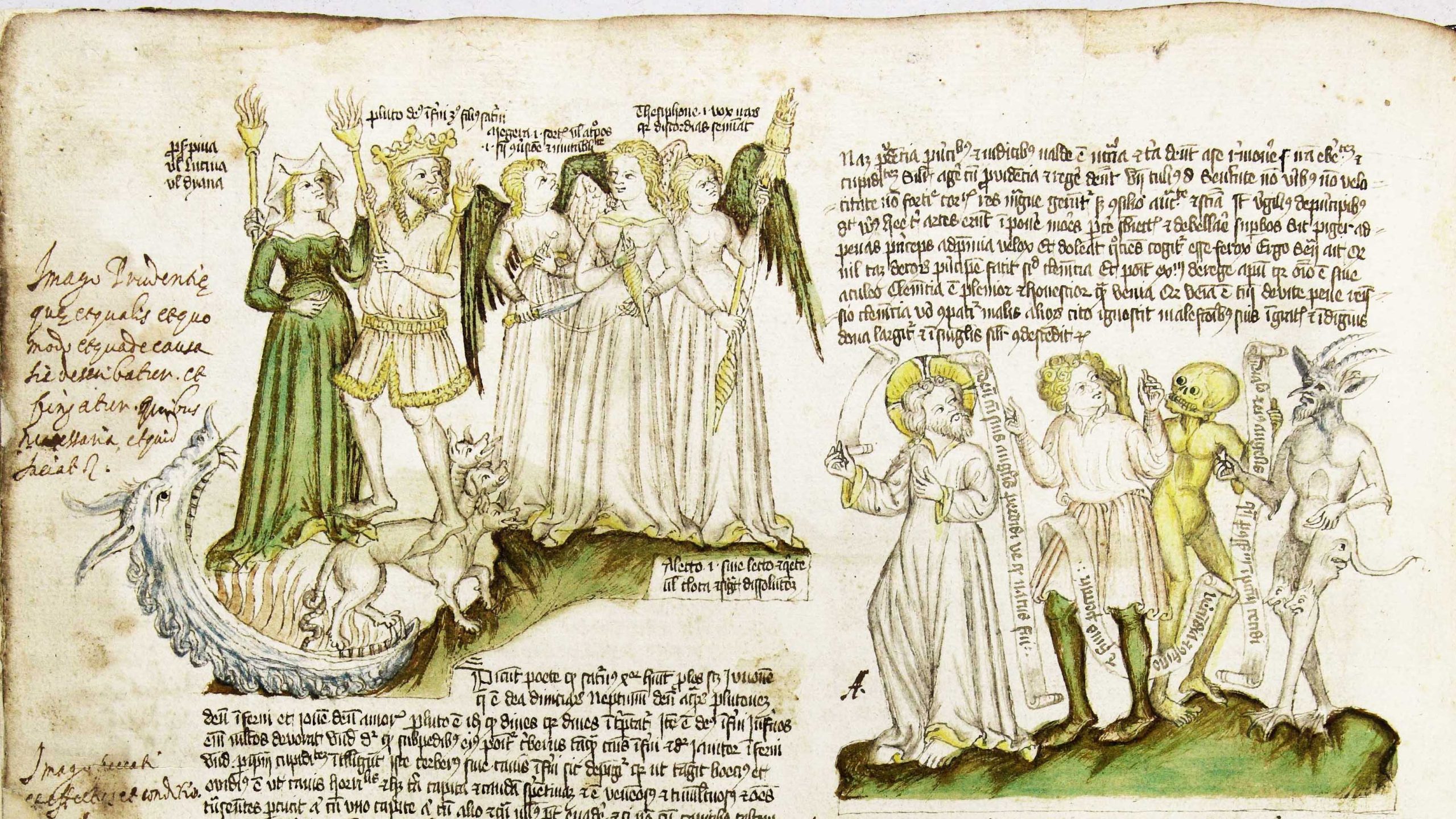
The manuscripts of the Wellcome scribe form an exceptional group of illustrated learned codices, written mainly in Latin and probably produced in Thuringia in the mid to late fifteenth century. Their combination of eschatological, moralising and medical texts, sometimes interspersed with vernacular sections, suggests an audience close to educational environments such as universities while also oriented towards practical life. The manuscripts reveal a characteristic late medieval tension between eschatology and care, moving between historical and individual eschatology on the one hand and spiritual and secular care, salvatio and cura, on the other. This conference explores this mentality and its intermedial expression in the manuscripts.
One of the six known codices is preserved in Rome at the Biblioteca Casanatense, in close proximity to the Istituto Svizzero. This ecclesiastical composite manuscript contains numerous pictorial texts, including representations of virtues and vices, moralising tree diagrams and political prophecy. Its presence in Rome offers a particularly fitting context for scholarly discussion. On this occasion, an international group of researchers from art history, literary and religious studies, and the history of science and medicine will gather to examine the manuscripts and reinterpret the transmitted texts in relation to their images.
Centred around the idea of knowledge transmission, the conference will deal with the following main objectives: the materiality of the manuscripts (manuscript composition in parchment and paper, forms of layout, intermedial relations) – textual, pictorial, and musical traditions creatively assimilated in the contents – the context of the ‘new’ medium of early print: blockbooks as a model – the role of the manuscript group in late medieval mentality (religious and moralising practices, pre-reformatory thinking, the idea of ‘future life’ expressed in eschatological and prophetical thought, ‘care’ as a substantial value for this world and for the idea of afterlife) – the place of the manuscripts in intellectual history (didactic and cognitive strategies; text-image-correlations as means of knowledge transmission; the broader contexts in the history of writing, reading, and intellectual development).
PROGRAMME:
14.04.2026
H09:00-H09:30
Institutional Greetings
Ilyas Azouzi (Istituto Svizzero)
Introduction
Marilena Maniaci (Università degli studi di Cassino e del Lazio; President of the Comité international de paléographie latine) & Michael Stolz (University of Bern)
H09:30-H10:30 Opening Lecture
Chair: Michael Stolz
Martina Roesner (College of Theology – Chur, History of Philosophy and Theology)
Missing the forest for the trees. Advantages and limitations of arboreal schemata in the late medieval systematization of philosophical and theological knowledge (Rome, Biblioteca Casanatense, MS 1404)
H10:30-H11:00 Coffee Break
Session I: The Materiality of the Manuscripts of the Wellcome Scribe
Chair: Marilena Maniaci
H11:00-H12:15 Christine Putzo (University of Bern, Literary Studies) & Henrike Lähnemann (University of Oxford, Literary Studies)
Transmitting Faith Affectively – the Diagrammatical Way. With New Hypotheses on the Origin and the Religious Context of the Wellcome Manuscripts
H12:15-H14:00 Break
H14:00-H14:45 Elena Brandazza (University of Bern, Literary Studies)
Biß als die byne wize, / Trag hie yn, so hastu dort die ewige spize. Commutazione di Codice e Guida del Lettore nei ‘Testi Pittorici’ Arborei (Roma, Biblioteca Casanatense, MS 1404)
Session II: Textual, Pictorial, and Musical Traditions
Chair: Katharina Heyden (University of Bern, History of Christianity)
H14:45-H15:30 Britt B. Hunter (Florida State University, Art History)
Representations of Death and Eschatologies in Rome, Biblioteca Casanatense, MS 1404, and London, Wellcome Collection, MS 49
H15:30-H16:00 Coffee Break
H16:00-H16:45 Greti Dinkova-Bruun (Pontifical Institute, Toronto, Literary Studies)
The Role of Poetry in the Pictorial Program of the Wellcome Scribe: Case Studies from Biblioteca Casanatense, MS 1404
H16:45-H17:30 Stefan Abel (University of Bern, Literary Studies)
La fortuna è donna – ‘Global Misogeny’ in Rome, Biblioteca Casanatense, MS 1404
H17:30-H18:00 Break
H18:00-H19:30 Evening Lecture
Chair: Michael Stolz
Daniela Mairhofer (Princeton University, Classics)
Political Prophecy in Rome, Biblioteca Casanatense, MS 1404, and London, Wellcome Collection, MS 49
15.04.2026
Session III: The Place of the Manuscripts in Intellectual History and Medical Practice
Chair: Elma Brenner (Wellcome Collection, London, History of Medicine)
H09:00-H09:45 Racha Kirakosian (University of Freiburg/Br., Literary Studies)
Scientific Discourses in Late Medieval Europe. The Wellcome-Scribe in Context
H09:45-H10:30 Laurence Moulinier-Brogi (Université Paris Nanterre, Medical History)
The Medical Section in London, Wellcome Collection, MS 49
H10:30-H11:00 Coffee Break
H11:00-H11:45 Iolanda Ventura (University of Bologna, Medieval Latin)
The Manuscript Tradition of the ›Circa instans‹ and the Wellcome Scribe
Session IV: The Role of the Manuscript Group in Late Medieval Mentality Chair: Martin Roland (Institute of Medieval Studies, Austrian Academy of Sciences, Vienna, Art History)
H11:45-H12:30 Patrick Nehr-Baseler (University of Kiel, History)
Late Medieval Future Thinking: Imagination and Order in the Manuscripts of the Wellcome Scribe
H12:30-H14:00 Break
H14:00-H14:45 Katharina Heyden (University of Bern, History of Christianity)
Structuring vices and virtues, mapping the Holy Land: the question of folio 27 in Rome, Biblioteca Casanatense, MS 1404
H14:45-H15:30 Peter Schmidt (University of Hamburg, Art History) Representations of Jesus – from Names to the Man of Sorrows in Rome, Biblioteca Casanatense, MS 1404
H15:30-H16:00
Summing up and Discussion of Future Plans
Chair: Michael Stolz
H16:30-H18:00 Agata Mazurek (University of Bern)
Consultation of Rome, Biblioteca Casanatense, MS 1404
The event may be photographed and/or video recorded for archival, educational, and related promotional purposes. By attending this event, you are giving your consent to be photographed and/or video recorded.
SAVE THE DATE
Inscrivez-vous à cet événement pour recevoir une notification par e-mail
Roma, Biblioteca Casanatense, Ms. 1404, fol. 33v, detail